 Blogcritics The critical lens on today's culture & entertainment
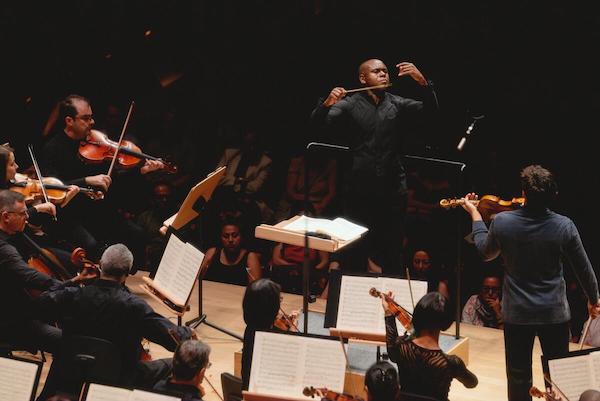
I had the good fortune last week to hear the Festival Orchestra of Lincoln Center twice, in its first season since its name change. For the 2024 Festival, the buzzed-about “Converse Conductor” Jonathon Heyward took the helm of the former Mostly Mozart Orchestra, debuting with the ensemble at David Geffen Hall with a program of Beethoven and contemporary composer Huang Ruo. Then on Friday, guest conductor Kazem Abdullah delivered focused and insightful readings of the Brahms Violin Concerto in D Major, with soloist Benjamin Beilman; Stravinsky’s full Pulcinella ballet score; and, in its 50th anniversary year, Louis W. Ballard’s powerful 1974 lament Incident at Wounded Knee.
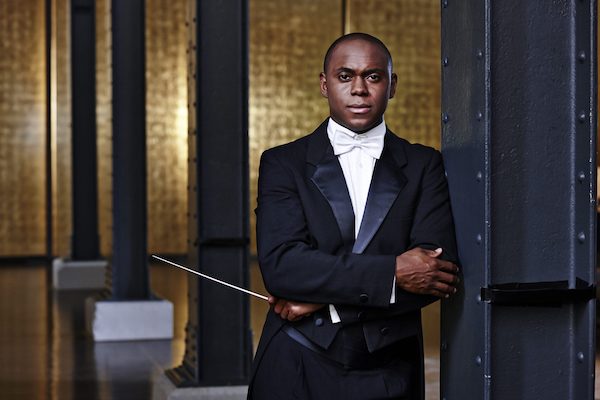
It was a bold choice to open, rather than close, with the Brahms Violin Concerto. With its muscular and orchestration and heady emotion, this is a showpiece if there ever was one when graced with a superb soloist such as Mr. Beilman. It’s also essential to the canon of its era, a sublime blossoming of the Romantic style. Mr. Beilman undertook the task with what seemed total confidence. With pinpoint intonation, a fine balance of expressivity and technique, and enchanting suavity he resembled a less aggressively self-assured Joshua Bell. (And I don’t make such a comparison lightly.)
Brahms, Still Fresh
Something else, something less definable, stood out just as much in Mr. Abdullah’s Brahms. This was how the operatically experienced conductor made a whole universe out of the first movement. Stately pacing and a beautifully sustained fluidity allowed all the colors and voices to emerge, even before the soloist’s first entrance. Mr. Abdullah has an intense onstage style that was reflected in the judiciously calibrated dynamics and undulating rhythms that characterized the performance.
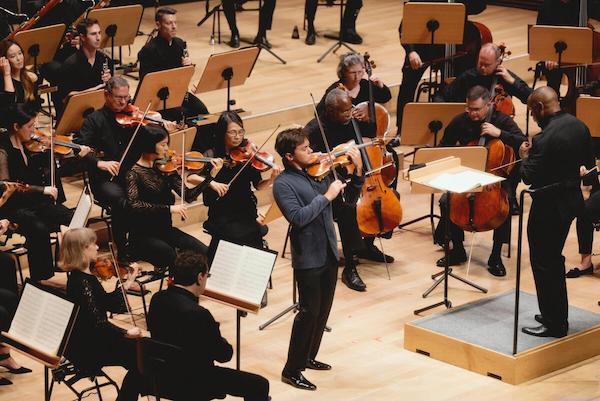
As for Mr. Beilman, his honeyed, resonant tone allowed the cluster of harmonics unique to the violin to surge. Every phrase and gesture felt directly meaningful, including in a substantial cadenza.
The second movement’s gentle narrative flowed with sweet harmonies, Mr. Beilman’s violin singing brightly against the now quieter accompaniment. Unlike what often happens to me when I hear this concerto, I got so lost in the music of the moment during the first and second movements that the magnetic third, to me the most thematically memorable, slipped completely out of my mind and arrived almost as a surprise. It also carried quite a release of tension. The violinist produced a rich, deeply bowed sound, and the conductor brought out the music’s high spirits in a succinctly measured style, perfectly proportioned and not overdone.
Incident at Wounded Knee
I had never heard Incident at Wounded Knee before, but the performance was thoroughly convincing. Though somber it was infused with vigor and precisely detailed.
The music also had an impassioned quality that harked back in a stark way to the Brahms. Ballard was an innovator in fusing Native American folk sounds with classical instrumentation. With the string section greatly reduced in size, the French horns and woodwinds gain prominence. The first of the four brief movements, “Procession,” felt something like a heavy war dance. Then, led by a plaintive solo cello, “Prayer” indeed had a pleading quality. “Blood and War” depicted a stealthy sort of warfare, one that felt in tune with nature even as the warriors’ hearts pounded in flurries of triplets. The suite ends with the stylistically complex “Ritual.”
Now half a century old, to these fresh ears the music has more than held up even as 21st-century composers like Jerod Impichchaachaaha‘ Tate extrapolate this hybrid form of Native American cultural flowering in their own distinctive ways.
Bravura Shepherding
A rousing rendition of of Stravinsky’s crowd-pleasing Pulcinella occupied the concert’s second half. The orchestra and three singers performed the full ballet score, 21 pieces and songs about shepherds and shepherdesses falling in love and getting married – and what does and does not ensue. Tenor Chris Lysack’s voice had a burnished sheen, soprano Heather Buck sang with a warm sparkle, and bass Edwin Jhamal Davis’s glowing overtones resonated in every acoustically tuned corner of the hall.
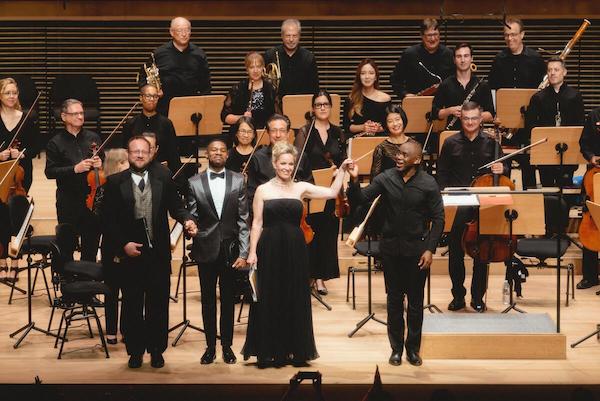
This is fun music, but its many short and widely varied numbers force conductor and orchestra to shift gears rapidly and continually. Stravinsky had stepped back from his in-your-face experimentation to put his own stamp, sometimes surprising, sometimes humorous, on classical forms and rhythms. Mr. Abdullah led the ensemble from instrumental to song and back with flexibility and aplomb. The music-box twinkle of the fourth number (Poco più vivo); the gorgeous three-part vocal harmonies of the Trio “Sento dire no’ ncè pace”; the brisk Tarantella; the “Gavotta” woodwind ensemble feature; the familiar, punchy melody of the “Vivo” near the end – 21 pieces in all added up to a dizzying delight.
The program was repeated on Saturday night, and the Lincoln Center Summer for the City festival continues through August 10, including more performances by the Festival Orchestra led by new music director Jonathon Heyward and guest conductors. As far as I’m concerned, Kazem Abdullah, who made his Metropolitan Opera debut last fall with a much-discussed production of Anthony Davis’s X: The Life and Times of Malcolm X, is welcome back any summer in New York City, and I hope Lincoln Center agrees.