 Blogcritics The critical lens on today's culture & entertainment
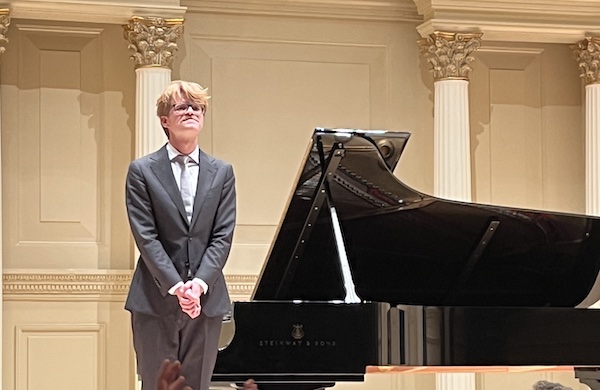
Canadian pianist Carter Johnson most recently made news as the silver laureate at the 2025 Honens International Piano Competition. But it was the Dublin International Piano Competition, where he’d taken the top honor earlier that year, that ushered him onto the stage for his Carnegie Hall debut at Weill Recital Hall on November 4, 2026.
There was nothing unusual about the composers Johnson chose for the occasion: Schumann, Bartók, and Schnittke. Still, the works added up to a striking program, particularly the first half, where Johnson knitted together music by all three composers. By playing the pieces contiguously, without pausing for applause, he found affinities and even resonances that opened unexpected windows on all, while displaying an appealing, twinkle-in-the-eye kind of showmanship.
A Well-Knitted Program
First up was Robert Schumann’s “Arabeske” in C Major. To the twirls of notes in the main sections Johnson applied a supple touch. To the main minor-key episode his approach was firm and expressive. A timeless tempo that felt rather modern took over as that section worked hesitantly back to the main theme. The hall has good acoustics for piano, provided a performer modulates their power appropriately; Johnson had evidently sussed out the room and moderated his force, shaping the sound comfortably. That became more important during the Schnittke Prelude and Fugue that followed.
Despite the great contrast between the Schumann and the Schnittke, the segue created a welcome sense of continuity, making the pieces seem to belong more to the pianist than to their creators. Johnson played the aggressive Prelude with an insouciant, even insolent ease that felt just right. The Fugue provided quite a thrill, with vigorous, sharply defined phrasing and fiery, yet controlled energy, summed up in a titanic sequence of crashing chords at the end.
The piano took a good deal of pounding. (I recalled attending a concert at this very hall some years ago where a performance of Schnittke’s music necessitated a re-tuning of the piano during intermission.) But there was no excess or harshness, and Johnson glided on, back to Schumann, this time to the tail end of Robert’s oeuvre, the Ghost Variations.
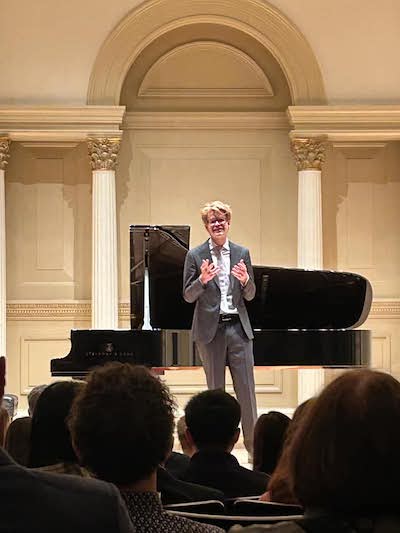
Johnson laid out the theme in a gravely simple style, then made the first variation’s smooth, flowing triplets catlike. The bell-like harmonies of the second variation gave way to the third’s showers of spidery notes in the treble, scattering over the theme shouldering below.
In Johnson’s rendition the minor-key fourth variation seemed constructed of discrete blocks of sound, slow and angular – and meltingly sad. One could feel a contrast in mood not just with the happier variations but with the excited bangings-out of the Schnittke, again partly because of the contiguous performance.
I took a surprising (to me) number of notes on Johnson’s distinctive, vaguely modern-sounding rendition of the final variation, which Schumann wrote after recovering – for the moment – from his famous attempt at suicide by drowning. The ghostly harmonies had a shrouded, sliding quality, and a spirit that suggested a kind of contentment. Johnson pedaled generously and played quietly throughout. Tension alternated with gentle resolve.
Bartók’s Only Piano Sonata, and Schumann’s Carnival of the Emotions
From here he plunged directly into the Bartók Piano Sonata. To the first movement he brought assertive power that recalled the Schnittke. He careened through the tempo changes smoothly, with impressive rhythmic interplay between the hands. (It’s interesting to note that as a finalist at last year’s Van Cliburn International Piano Competition he performed Ravel’s Piano Concerto for the Left Hand in D Major.)
In the wistful second movement, with its suggestion of mis-tuned bells, I couldn’t help picking out accidental echoes of the “Morse code” theme in the Schnittke. It was also easy to read the much-slowed-down folk rhythms that permeate the faster movements, including the exuberant finale, to whose sly warbles Johnson applied a nimble glow.
In the second half Johnson returned to Robert Schumann for the 18 short pieces of the Davidsbündlertänze. As the pianist described to us, here Schumann seems to cover just about the whole gamut of human emotions. That came through strongly. Lighthearted and serious (sometimes at the same time, as in No. 1); pensive and boisterous; romantic (hopeful, flowering, passionate); loving and furious; quarrelsome (No. 5) and companionable; devilish and smiling; slumbering, waltzing, sparkling – it was all there in a tour-de-force performance of emotional variety and intensity.
Throughout, Johnson showed why he won the Dublin International Piano Competition and has been so successful in other recent meets. At the same time, his assured yet humble mien suggests an artist who is more creatively engaged than obsessively competitive. His virtuosity is understated even while on full display, as it was last night at Carnegie.
Follow Carter Johnson at his website.