 Blogcritics The critical lens on today's culture & entertainment
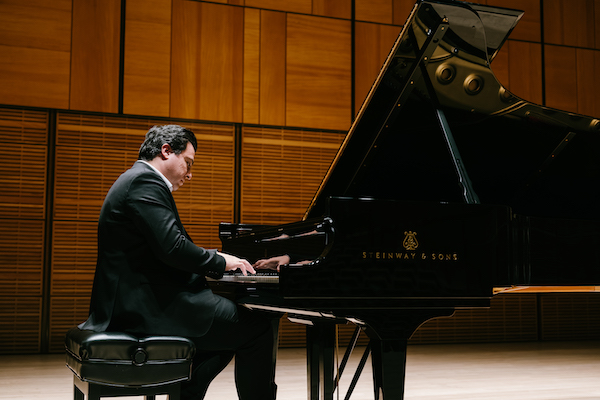
Hungarian pianist János Balázs dazzled at Carnegie Hall’s Zankel Hall on Monday night, performing with hearty virtuosity a program of very difficult music. There was too much Liszt on the program for my comfort, but otherwise I deeply enjoyed Balázs’ display of extraordinary skill and vivid personality in music by Chopin, Robert Schumann, and, within my (admittedly very personal) limits, Liszt too.
The concert was part of the pianist’s Cziffra Festival, a series Balázs has created to honor and promote the legacy of Hungarian pianist György Cziffra (1921–1994). Cziffra was a master of the Romantic piano literature that Balázs takes so much to heart. The hall so resounded with this music that by the time Balázs returned to the stage to play an encore, I was pretty sure I heard notes that had gone out of tune.
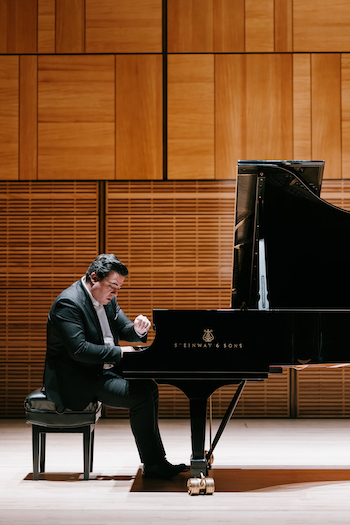
The evening opened with Liszt’s piano transcription of the Schumann lied “Widmung.” This small dose of Liszt had a satisfying, lush gravity, offering just a taste of the blizzard of notes that was to come.
But in fact, Balázs continued with Schumann’s Carnaval. With all its glorious variety, this set of episodes lives in the same dimension of classic Romanticism as other great music of the era by Brahms, Chopin, Clara Schumann, and of course the rest of Robert Schumann’s oeuvre. I adored this rhapsodic performance. It embodied all that the composer imbued it with, from tempestuousness to feathery lightness and everything in between. It made me smile often.
Time Travel
Though rhythmically free and with plenty of dynamic flair, Balázs’ Schumann was always intelligible and under control. It also revealed aspects of the set that I hadn’t reckoned with before, despite many listens. In one piece I heard what sounded like a precursor of stride piano. Other sections call for stretched rhythms that always deceive the ear into thinking they are written in 7/8 or 5/4 time; but in Balázs’ rendition, time felt consistently and thoroughly natural, such that these rhythms clicked in ways they hadn’t for me before.
The performance added up to a veritable cataclysm of powerful emotion. That energy carried through, and then some, into the Spanish Rhapsody, S. 254, of Franz Liszt. Here the pianist produced showers of notes, curtains of sound, and shadowy depths – all in the first minute or two. Nonetheless the themes rang pretty cleanly. The sparkling, dance-like treble section was very fine. In some of the busiest passages one heard a bit of mud, but no more than in most performances of these extravagant showpieces.
All the bluster became too much for me after a while. And let me just say that I do not at all blame the redoubtable János Balázs for that. His wizardly virtuosity shone throughout, even when the composer had fallen off the deep end.
The “Grande Polonaise Brillante” of Chopin’s Op. 22 had epic intensity too, but as always with Chopin, the sense is that the composer was working to touch, not overwhelm, the listener. Given this reading, it made sense that Balázs, a pianist I’ve not heard before, has received a Polish accolade for his performances of Chopin’s complete works. I was especially moved by his lovely, warm rendition of the preceding “Andante Spianato.”
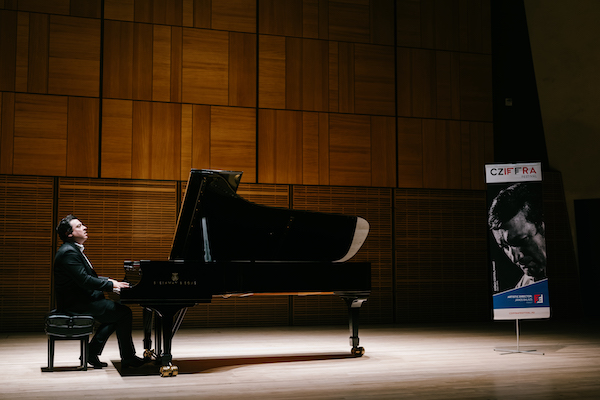
Returning to Liszt, he then gave us the Hungarian Rhapsody, No. 12. This opus is far more digestible than the Spanish Rhapsody, and on a more human scale. It’s also more thematically integrated, wittier, and thus altogether more fun to listen to. The performance reflected an ideal marriage of material and musician. Liszt, who still reigns in the classical music world as Hungary’s most prominent composer, has a wonderful champion in János Balázs even if I can only take the music in moderate doses.
The program closed with a real treat, the difficult “La Valse” by Ravel. Balázs played its extravagant rumbles and off-kilter harmonies with imagination, sensitivity and a knowing wink. Like the Liszt selections, it carries a titanic eruption of notes, and as I was not very familiar with it, I can’t even tell you if he got them all right. But it was a joy to hear. For an encore, he returned to Liszt with the Hungarian Rhapsody No. 6, a shorter crowd-pleaser that again called for daunting virtuosity. It capped an evening filled with fine artistry and hearty virtuosity – all sustained by extraordinary stamina.