 Blogcritics The critical lens on today's culture & entertainment
Every year, Young Concert Artists (YCA) auditions some of the best of classical music’s up-and-coming musicians and ensembles and names the top performers to its hallowed roster. YCA has helped launch the careers of some of classical music’s leading lights: Emanuel Ax, Pinchas Zuckerman, Dawn Upshaw, the Tokyo String Quarte, Anne-Marie McDermott, Randall Goosby, Anne Akiko Meyers, 2025 Van Cliburn winner Aristo Sham – the list goes on, including 2025 winners Trio Azura, whom I heard just last month at Carnegie Hall’s Zankel Hall.
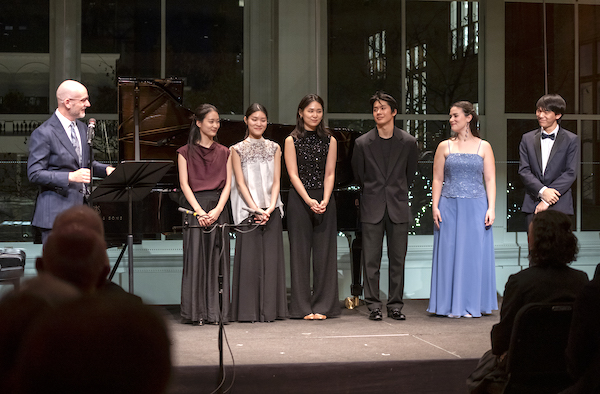
The honor comes with many benefits for the young artists’ careers, including prestigious concert bookings. YCA celebrated its 2026 winners with special performances at Weill Music Room at Carnegie Hall on Monday night. Canadian soprano Bridget Esler, American pianist Taige Wang, and the Korean-born, New York-based Dōnum String Quartet offered samples of their capacious talents in challenging repertoire. We also got to know the musicians a bit in brief on-stage interviews by YCA president Daniel Kellogg.
The Dōnum String Quartet Gifts Us with Ravel
The members of the Dōnum Quartet met during their high-school years in Korea. The members studied at different conservatories in the United States – Juilliard, Yale, and the New England Conservatory – but worked together all the while. Their talent and hard work have earned them not only the YCA award but, as of this summer, the post of Juilliard Graduate Resident Quartet.
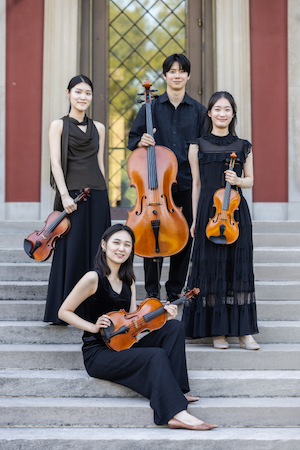
For the audience at Carnegie they played the first and fourth movements of Ravel’s String Quartet in F Major, M. 35. Individual voices shone through amid energized ensemble work in the first movement. Ravel marked this movement as “très doux” – very soft. The performance might not have quite aligned with that, and it didn’t need to – these young musicians had the subtlety and synchrony needed to develop a very moving interpretation.
They showed maturity in the fourth movement too. Marked “fast and agitated,” it requires melodic investment as well as frenzied, rhythmic energy. The musicians certainly showed off their muscle, the bright melodic sections rocked, and ultimately the performance fully inhabited the piece’s riches.
My only complaint: I wished I could have heard them play the other movements too! But of course this concert was a sampling, not a full program. I look forward to following the Dōnum String Quartet into a distinguished career.
A Teenage Tiger
While the other artists are in their mid-20s, pianist Taige Wang is just 16, yet his career is already off to a blazing start. He’s made solo appearances with the likes of the Cleveland Orchestra, has been a fellow at the Aspen Music Festival since 2024, is a Steinway Artist, and was featured on NPR’s From the Top, to name a few, with many upcoming bookings resulting from his YCA honors.
It was no surprise that Taige (pronounced “Tie-guh”) chose the very difficult “Transcendental Etude No. 4” by Liszt as one of his showpieces for the select Carnegie audience. In an impressive performance he produced a cavernous sound from the piano (it’s not a big room) while negotiating the virtuosic hand-over-hand and other confoundingly difficult passages with seeming ease. And he applied a sensitive touch to the lyrical section in the middle.
But it was in his other selection, No. IV from Granados’ Goyescas, Book I, Op. 11, that Wang’s surprising maturity really emerged. He gave a transportive performance of this emotionally sophisticated work, displaying adult sensitivity and uncovering a crispness within the flow, all with an exquisite touch and interesting colors. Bravo.
Britten, Bach, and Messaien from a Gifted Soprano
The Dōnum Quartet took their name from the Latin word for gift, and the term “gifted” surely applies to all this year’s YCA honorees. But the word jumped into my mind most dramatically with soprano Bridget Esler’s performance of three bravely chosen vocal selections.
She opened with a great showpiece for both technique and timbre: “Let the florid music praise” from On This Island, Benjamin Britten’s cycle of W.H. Auden settings. With thorough, indeed “florid” confidence Esler brandished a bronzed mezzo in an epically expressive rendition, with buttery-smooth shifts between registers – altogether distinctive and without preciousness.
Even better was her Bach. Music from the St. Matthew Passion further revealed her glowing upper register and milky lower range. Her phrasing and breathing choices were so natural-sounding that I followed word to word without – except with an effort to exercise an intentionally critical ear – even giving a thought to technique. For this, it’s worth noting that accompanist Michele Wong’s sensitive, temperate pianism shares credit.
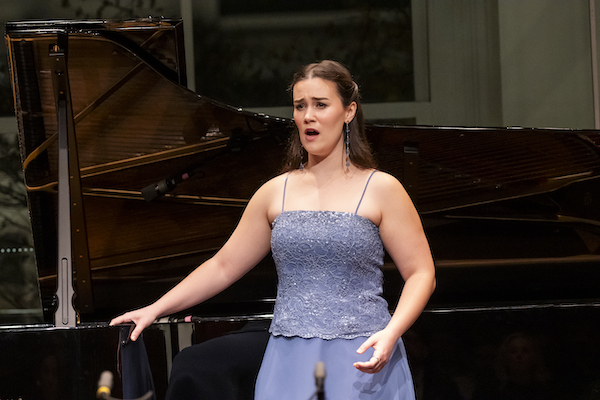
Esler proved equally at home with modernism in the “Résurrection” from Messiaen’s Chants de terre et de ciel. Her big, assertive performance was also – through some magic of her own – rather warm and conversational. Here, and in her whole mini-set, she deployed her organic-sounding dexterity in the service of strength of expression worthy of opera – or indeed of some exalted cabaret.
Bridget Esler does indeed have an extraordinary gift. Like this year’s other honorees, she lives up to the collective reputation of Young Concert Artists winners over the decades. Esler expressed admiration for Dawn Upshaw in particular. I don’t see any reason her own name couldn’t become just as renowned.
Young Concert Artists also announced a second tier of recognized young artists, the Laureates, who receive a $5,000 grant and a place in the semifinals of a future YCA audition round. This year’s Laureates are pianist Yang (Jack) Gao, violinist Tianyou Ma, and violist Emad Zolfaghari. Congratulations to all.