 Blogcritics The critical lens on today's culture & entertainment
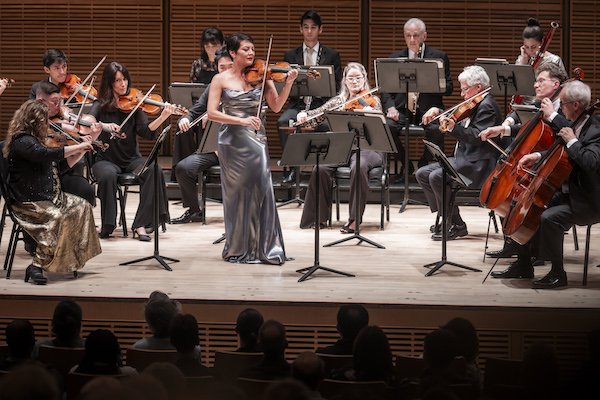
Debates about the appropriateness of artistic responses to tragedy and destruction won’t be settled in one night at Carnegie Hall. But “The Pacific Has No Memory,” which bloomed from the musical pen of Eric Whitacre after he witnessed the Los Angeles-area wildfires of January 2025, showed one thing without a doubt at its May 17 New York premiere with violinist Anne Akiko Meyers and the Orpheus Chamber Orchestra: that such responses can carry notes of both melancholy and hope.
The piece was a focal point of “Taking Flight,” a program that closed Orpheus’s 2024–25 season this weekend with music that tilted strongly toward good humor and poetic beauty. The concert opened and closed with the New York premieres of arrangements of classical music standards, with newer and some very contemporary work in between.
Haydn Takes Wing
Orpheus violist Dov Scheindlin transformed Haydn’s popular String Quartet in D Major (“Lark”) into a songful “symphony” for string chamber orchestra. The arrangement both deepened the core material and bared its parts in interesting ways.
Haydn’s first movement features the first violin singing like a bird. This was not lost in the new transcription, partly because some of these parts were indeed played solo by the first violinist, but also because the arrangement reveals – and reinforces – each of the four independent parts so nicely. Scheindlin gracefully balances lightness and fullness, retaining the feel of the original string quartet while taking judicious advantage of the resonant possibilities of Orpheus’ full (though small) string orchestra.
The Adagio too felt quite natural in its new guise – again, both light (the word that came to my mind at first was “spidery”) and rich. The quick Menuetto, too, featured solo moments that vividly expressed the raw material in a new way without overdoing any of the modifications.
The audience responded with happy gasps to the movement’s sudden ending, thanks to Orpheus’ winking stage presence, only to be swept up in the sixteenthth-note attack of the Finale, including many unison parts played by this conductor-free ensemble with agile synchrony. It made me wonder if this achievement might actually be easier without the musicians having to be looking up and following a conductor, and instead being able to live fully in their intra-communication like the four members of a literal string quartet.
I suppose my supposition will have to remain only that for now. What was certain was that the group continued this deep connection in its transportive performance of Caroline Shaw’s “and the swallow.” Originally a choral piece, this work was here revamped for string orchestra (though still for lower-case letters only) by Julian Azkoul.
Unlike in the original version, the opening minutes felt danceable. (Or was I still just echoing with the energy of the dance parade I had watched earlier in the day? That annual, aggressively multicultural celebration is, like Orpheus, an essential New York City cultural institution.)
Taking Flight…
Anyway, like the dancing, the piece sounded alternately meaty and ethereal, making it an excellent companion for “The Lark Ascending,” the Ralph Vaughan Williams hit that followed. After the musicians left the stage for a few moments to retune (and perhaps to check on the results of the Eurovision finals), the always gracious Anne Akiko Meyers, rather than waiting to make a diva-style entrance, took the stage together with the orchestra.
Not surprisingly, the audience nonetheless greeted her with a star’s welcome.
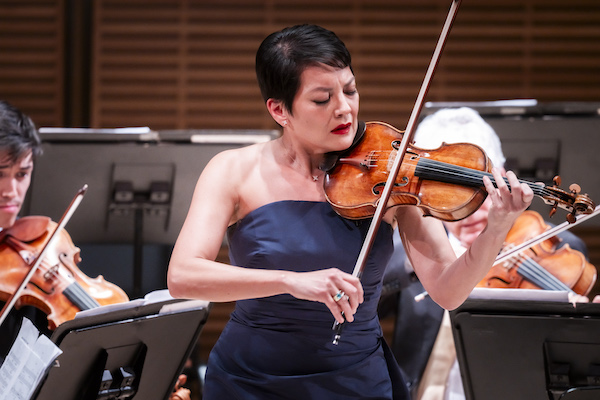
“The Lark Ascending” is a great Romanticism-infused showcase for a violinist. Meyers has been playing it for decades, and she and the Orpheus both seemed at ease with the work’s liquid flow and warm pentatonic sound world. Meyers’ performance revealed the glorious singing tone she and her violin, the 1741 Ex-Vieuxtemps Guarneri del Gesù, are known for. (See our recent interview with Meyers where she discusses the works on this concert program, her new and upcoming albums, and her instrument.)
Soloist and orchestra were in lockstep. The same held in Eric Whitacre’s new composition. But there, Meyers seemed more physically wound into the ensemble, cuing them with body language and adding extra stage presence to her own playing.
Whitacre’s “The Pacific Has No Memory” is an exquisite piece of neo-Romanticism. It’s rather short, perhaps because Whitacre composed it in a relatively short time. He had devoted many months to a different realization of Meyers’ commission, but switched gears upon witnessing the wildfires and conceiving a pungent new melody.
The tune and its variations are melancholy but also hopeful. For strings only, the piece bathes in rising scales, dramatically descending harmonies, and mild, dissolute dissonances. Whitacre’s writing features inspiring, even brilliant interplay between soloist and orchestra. If the solo violin is lamenting the destruction of homes and neighborhoods, the orchestra is contextualizing that lone voice into a chorus of community.
Terrible circumstances can indeed inspire work of aesthetic beauty.
…to the Moon
A Haydn string quartet is one thing, but an orchestration of Beethoven’s Sonata No. 14, the famous “Moonlight”? I had my doubts about the evening’s second reconfiguration of a classical-era standard. Isn’t this immensely popular sonata “orchestral” enough already (the first and third movements, at least)?
But in this new arrangement by Sahun Sam Hong, the music’s emotional and musical density fed profitably into an orchestral setting. Hong didn’t try to do too much. He preserved the intense passion and, particularly in the second and third movements, had fun with it. I have to admit I smiled uncontrollably all the way through them.
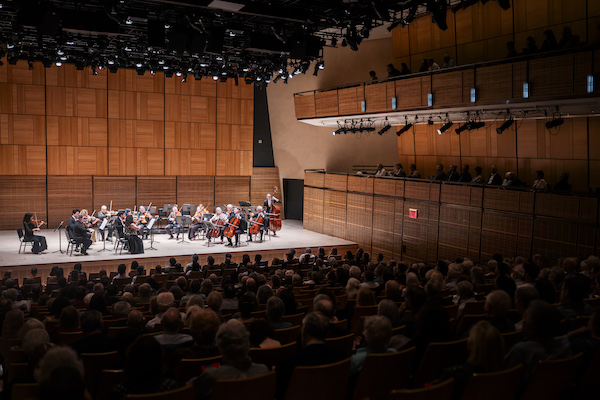
In the sorrowful (and ubiquitous) first movement the violas play the mournful triplets, as different instruments – horn, woodwinds, trumpet – take up the muted yet unforgettable melody. Created for Orpheus, the arrangement is straightforward, not flashy or flowery, and has the courage of its convictions.
The festive Allegretto transmuted easily to orchestra, with its terpsichorean syncopations and rapidly evolving melody.
The finale, marked “Presto agitato,” is baked into my brain (though alas, not so much my fingers anymore). It’s in deep, right there with “Won’t Get Fooled Again,” “(She’s So) Heavy,” and the Khachaturian Toccata. Playing the third movement of this sonata, denoted by Beethoven as “Sonata quasi una fantasia” (the “Moonlight” nickname came later, and not from the composer), was my number-one release for my adolescent frustrations. This crafty arrangement stirred it all up again, but with a joyful sheen.
The performance hung together beautifully. It felt exciting and “symphonic” like the piano solo original. The Orpheus musicians were clearly having great fun with it.
Or were they just excited that the Eurovision winner turned out be a countertenor from Austria, the motherland of classical music?
The Orpheus Chamber Orchestra will start its 2025–26 season with a free concert at Carnegie Hall’s Stern Auditorium. See the Orpheus website for information.
Anne Akiko Meyers‘ concert schedule is at her website, where you can also find out about her latest albums.