Blogcritics The critical lens on today's culture & entertainment
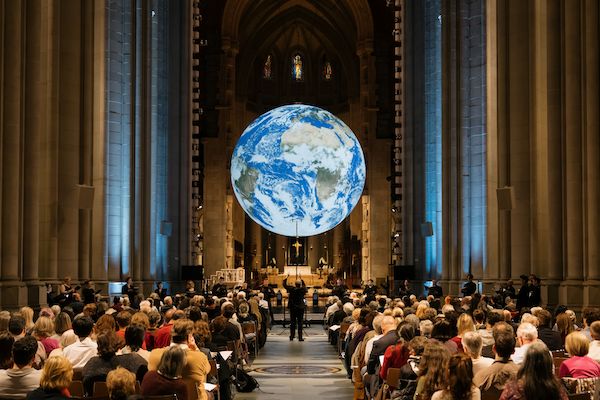
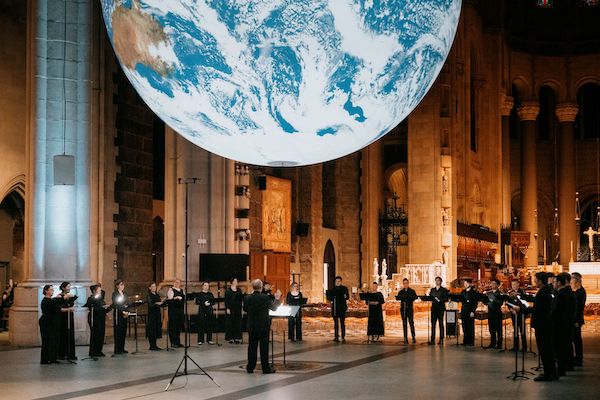
A tremendous, lit globe of the Earth rotates slowly in the air. The choir files into the huge central chamber of the Cathedral of St. John the Divine. They’re intoning in unison a short, simple Navajo prayer, “Now I Walk in Beauty,” to a melody by Gregg Smith.
The singers take positions in a single row in front of us – but very far in front of us. They’re so deep into the enormous church that the wordless music they proceed to sing sounds soft as silk. It’s the “Astronaut Anthem” of Meredith Monk.
The meditative sound glows like the globe. Flowing melodies in the upper and middle voices cruise atop droning tones in the lower, like satellites passing high above the surface of the Earth. Harmonic movement grows increasingly intricate as the sound gains in volume and intensity. An effect something like whistling wind intrudes.
Suddenly the piece is over. We have become immersed in the conceptual world of “SurRound: The Earth Remembers,” a program from the Musica Sacra Chorus led by Kent Tritle.
Heaven and Earth
Tritle, who also leads the Oratorio Society of New York, has conducted many concerts here at St. John the Divine, so he knows the cavernous space well. But I suspect he never performed under a giant spinning globe.
The program’s conceit was that the globe hanging overhead evokes the view of Earth from space, where astronauts report perceiving the planet’s fragility. The intention was to invite us to “consider our planet through music that explores the splendor of the Earth, our interconnectedness, and the responsibility we have for the future.”
From the future to the past: The chorus next reached back centuries, to the polyphony of the early Renaissance. The “Sancti Dei omnes” setting by Jean Mouton, a French composer favored by Pope Leo X, offers a prayer to the saints to “avert all the evils we justly deserve,” echoing the theme of atonement of the recent Yom Kippur holiday. Musica Sacra showed here the exquisite balance and control a choir must use in a cavernous space like this.
A Baptism in Sound
The Cathedral lends itself to immersive experiences. The singers positioned themselves around the audience as they sang a more complex reprise of “Now I Walk in Beauty” that carried a sense of peaceful chaotic motion.
Continuing to enfold us in this way, they then sang two contrasting contemporary works on a sea theme. The words of “Infinite Oceans” by Robert Paterson, a master of descriptive musical language, pinged and ricocheted off the church’s interior architectural elements. “Prière de la Baleine” (“Prayer of the Whale”) by Christine Whitten Thomas, a setting of an evocative poem by Carmen Bernos de Gasztold, was peaceful, consonant, melodic, and even comforting. In a way the music actually contrasted with the huge animal’s plea to escape pursuing whalers.
The program’s weighty centerpiece was the “Die Erste Elegie” of Einojuhani Rautavaara, one of the 20th century’s most important composers of choral music. Here the singers were back “on stage” facing us, but now much closer to us, which was important for appreciation of the piece’s depth. This technically demanding work has many sections, increasing tempo, and challenging solo parts. Rautavaara’s music fits the density and driving force of Rilke’s apocalyptic poem, which ends with an evocation of “Music, which was first to boldly penetrate the numbness.”
Down to Earth
In a pleasing development, the program then diverted to a plainspoken assertion of music’s transcendence: the “Earth Song” of Frank Ticheli. Next, the Psalm setting “in the swallow” by Caroline Shaw encapsulated that composer’s skill at vivid depiction, in this case the beauties of the natural world. (The “place of springs” mentioned in the Psalm brought up for me a sad contrast with the present strife-torn state of the Holy Land, however.)
Paterson’s setting of Czeslaw Milosz’s haunting poem “A Song on the End of the World” followed. The music descriptively enacts the lyrics, as with the blast of the “archangels’ trumps” and the repeated, numbing incantation “no other end of the world / There will be.”
The concert ended with two works on the theme of renewal. Again moving to enfold the audience, the choir sang “Take Peace,” another selection by Christina Whitten Thomas. This music sets a surprisingly zen message from the pen of the 15th-16th century monk Fra Giovanni Giocondo. It rises on “glory” and descends on “darkness.” But “There is radiance and glory in the darkness could / we but see – and to see we only have to look.”
Finally, the choristers processed toward the rear to the beat of a drum, singing in the Quéchuan language “Hanacpachap cussicuinin” by Juan Pérez Bocanegra. This is known as the earliest surviving piece of polyphonic vocal music ever printed in the New World. As a fusion of East and West, it was a fitting end to a thoughtfully programmed concert about our planet, performed beautifully and a cappella in one of the nation’s grandest spaces – a cathedral that, like the dream of a peaceful Earth, remains famously unfinished.