Blogcritics The critical lens on today's culture & entertainment

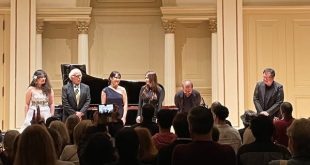
Words from Eleanor Roosevelt and Edna St. Vincent Millay. Music from Missy Mazzoli and Sarah Kirkland Snyder. Poetry and compositions from a raft of others. It all tolled through St. John’s in the Village in NYC on Tuesday night. Pianist and educator Joan Forsyth had put together a wide-ranging, historically informed program of new music by women, part of the Village Trip Festival.
Soprano Magic
I’ve admired soprano Sharon Harms for some time. She’s always ready to tackle new music of various sorts, including the challenging experimental kind. She appeared twice at this concert, first in a duet with the young soprano Curtlyn Ifill in “Topography” by Harold Meltzer, with a text by Sharon Olds. With Forsyth accompanying, that piece was’t ideal for the space, as the fully open grand piano threatened to drown out the singers – until the second, a cappella part of the piece arrived.
Fortunately, this problem didn’t persist in a big way through the evening.
Harms later gave the evening’s most striking performance, in one of three songs from Sin Ladder, a cycle by Kitty Brazelton. The segment included two poems by Marcella Remund, and another anonymous lyric, on the topic of the infamous Magdalene Laundries.
After Harms and Ifill joined mellifluously on “Cigarette,” Harms sang the mostly a cappella “The Book of Records.” The sparse accompaniment came from Forsyth striking the piano strings and producing a deep metallic twang.
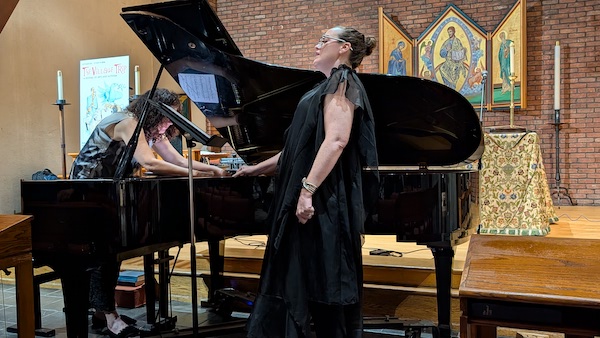
The piece began like a chant, but expanded into a maelstrom of passion. Harms drew on several vocal techniques to magnify lyrics like “Keep / our secrets until we’re gone, until God / Himself can judge us from His throne…What good / now for mothers to find their babies’ bones / to find sons grown and living down the lane…” The song and the performance had an extraordinarily powerful effect.
A Family Band
Harms sang the third song in a more operatic style, but in that one the music itself made less of an impression. It resembled, I imagined, a Joni Mitchell song that Joni had decided didn’t make the cut for an album. A better fusion of singer-songwriter and art music came from Liz Queler, with Seth Farber on piano and their son Joey Farber on bass guitar and vocals. Their The Edna Project sets to music the poetry of Edna St. Vincent Millay, and they brought out two Millay settings here, notably “The Ballad of the Harp Weaver.”
This music flirts profitably with the line between folk-pop and art song, and “The Ballad” is a creation of true beauty, almost a mini-suite. The compelling performance was flavored with Seth Farber’s profound pianism, Queler’s crystalline vocals, and Joey Farber’s warm-cool tenor harmony vocals and sensitive bass playing.
Intensity and Honesty
Full disclosure: I know Liz and Seth personally, from way back. Entirely new to me was soprano Isabel Fernandez, who proved to be, for me, the discovery of the evening.
Fernandez sang short pieces by Whitney George and Devon Lee. Much of “The Yellow Wallpaper” was spoken, but Fernandez recited just as artfully as she did in the sung parts where she deployed her expressive silvery timbre.
Her tone grew a bit smokier in the second song, “What I Know About Living,” which has a more traditional aria structure and a rolling beat like a barcarolle. Her voice had simultaneously a smoothness and a bite, easily cutting through Forsyth’s pungent piano accompaniment. The intensity and honesty of Fernandez’s performance impressed me greatly.
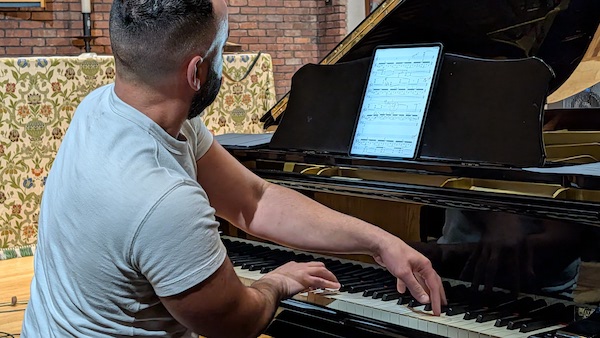
Though the program focused on vocals and poetry, it included a surfeit of fine pianism, not only from Forsyth and Seth Farber but from Adam Tendler and Anne Lovering Rounds. Tendler played an icily romantic gem from the unerring pen of Sarah Kirkland Snyder, Rounds a powerful perpetual-motion piece by opera composer Missy Mazzoli.
Kudos to all the performers, and to Joan Forsyth for putting them together in this fine concert. The Village Trip Festival continues through October 4, 2026 at various venues in Greenwich Village and the East Village.