Blogcritics The critical lens on today's culture & entertainment
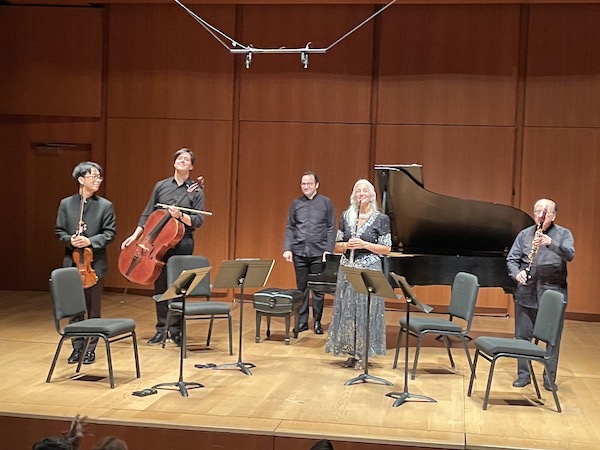
Victoria Bond never seems to disappoint, neither as a composer nor as a concert programmer. Her Cutting Edge Concerts series has for many years presented impactful new music and worthy, sometimes lesser-known performers. And as a composer she has that truly rare ability to construct music as attractive to general audiences as it is interesting for aficionados of experimental contemporary sounds.
Both specialties were strongly evident at her one-off “Tarot Magic in Music” program at the Morgan Library & Museum last night.
The Morgan presented this concert in tandem with its excellent “Tarot! Renaissance Symbols, Modern Visions” exhibit (on view through October 4, 2026). Bond’s own tarot-inspired composition Instruments of Revelation capped an evening of fun and beautiful music and impressive performances.
Cards on the Table
The program began with an arrangement for piano, violin, cello, flute and clarinet of the card scene from Georges Bizet’s Carmen. Even today, this must be one of the best-known appearances in popular culture of divination with tarot cards. Bond’s deft instrumental arrangement showed that voices and staging aren’t needed to convey the flavor of the action.
The connections to the tarot theme then grew hazier, but no matter, as each of the exceptional musicians got an impressive star turn. Ravel’s “Tzigane,” inspired by Hungarian Roma tunes, is a well-known showpiece for violin. Hahnsol Kim played with vigor and élan, building to an almost demonic virtuosity. The effect went from impressive to spellbinding when after a long solo section the piano accompaniment from Mohamed Sham entered. Moments of whimsy shone brightly amid the dark tumult. Bravo.
On a similar theme, but also only tangentially related to tarot as far as I can tell, Sham also joined cellist Michael Nicolas for an arrangement of “Songs My Mother Taught Me” from Dvořák’s Gypsy Songs cycle. This short and very sweet performance gained from Nicolas’s oaken timbre and from richly expressive playing from both musicians.
The Pipes of Pan and the Cards of Cremona
Flutist Carol Wincenc impressed mightily with two solo pieces. The winning and beautiful “Kokopeli” by Katherine Hoover flowed right into Debussy’s “Syrinx.” In this captivating performance the latter felt like a summoning of spirits. Bond connects the flute to the figure of the Fool, who is often depicted with the instrument in a tarot deck. She connects the Native American fertility deity Kokopeli with the Empress card. And she links the god Pan from the Syrinx legend to the Devil card. Fool card or no, Wincenc’s performance was all wisdom, intelligence, whispered emotion.
And while the tarot analogies may be somewhat fanciful, that’s the magic of tarot: It becomes what you choose to make of it. The cards’ symbolism has never stopped evolving since the first decks were created by hand in the early 1400s.
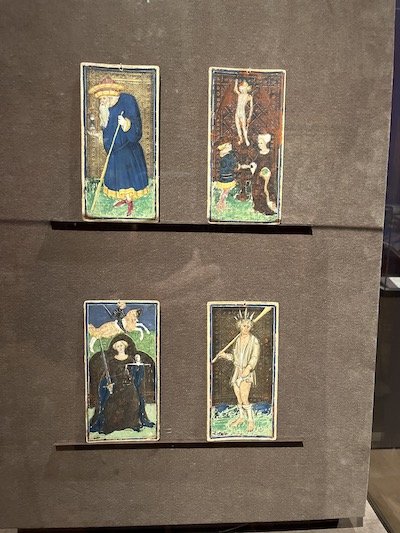
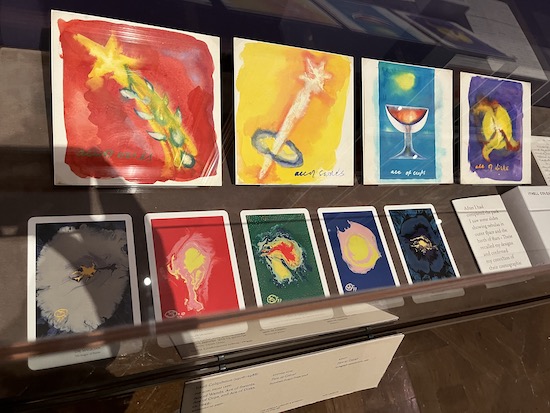
At first, tarot was a game for the educated upper classes, eager to show off their cultural knowledge. In later centuries people imbued the cards with mystical meanings and powers. The exhibit demonstrates this long and wide evolution. Along with showing a large selection of the earliest Renaissance tarot cards, as well as illustrated books from the same era, there is a whole separate gallery devoted to 20th- and 21st-century tarot decks and tarot-inspired art.
Playing Pierre Boulez’s “Domaines” for solo clarinet, Charles Neidich delighted the audience by shuffling from one corner of the stage to another in a calm, winking sort of jitterbug. The performance required a variety of techniques, from exquisite to funny, and the un-flashy Neidich was the perfect conduit for the piece’s joyful eruptions.
The score calls for the performer to play the movements in any order, Woyzeck-style – like shuffling a deck of cards. This performance took it further, with moves from station to station around the stage. At one point Neidich even hid behind the piano. If you ask me, contemporary classical music needs more of these kinds of games and hijinks.
Fool Me Again
Bond herself delivered the crown of the program with her four-movement Instruments of Revelation, played by the full quintet. The performance included the premiere of the brand-new final movement, which honors our old friend the Fool.
A different tarot card inspired each movement. “The Magician” movement is active, rhythmic, soaring – very suggestive of magical doings. A dominant bouncing beat, generally from the piano, supports a progression of gestures and motifs from the strings and winds. Hocus pocus was definitely in the air.
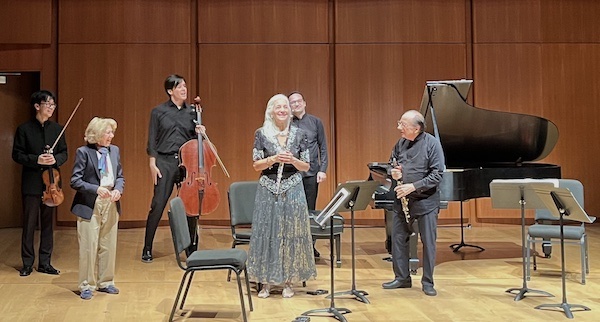
The ethereal “The High Priestess” evocatively groups lovely, sweeping colors. Much of the motion follows a folded and refolded pentatonic scale but Bond varies the modality to add sparks of tension as the music progresses. In “The Wheel of Fortune,” rolling three-note figures thread through deepening atmospherics that crescendo into sharply accented chords. There’s a compositional wizardry at work here as Bond slowly focuses the material toward an angular harmonic conclusion.
It’s a conclusion that would have been satisfyingly, well, conclusive. The addition of the delightful “The Fool,” however, ended the concert not with a dramatic bark but with a happy wink. Clearly Victoria Bond the composer remains at the height of her powers.
So does Bond the concert programmer. Contemporary music concerts rarely engage an audience with as much good humor as this one did, without sacrificing any of the artistic depth and drama in the music of composers past and present. Superb work all around.