 Blogcritics The critical lens on today's culture & entertainment
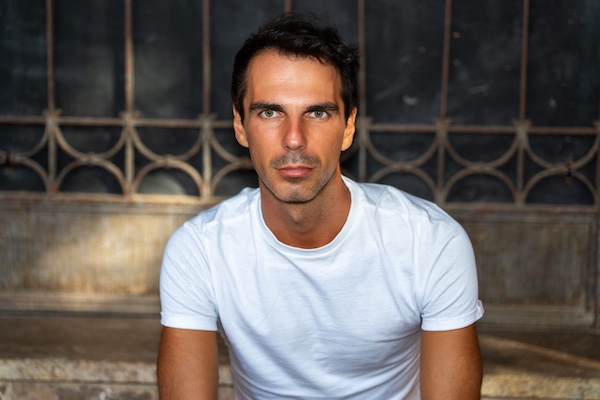
Romanian-Ukrainian composer Adrian Mocanu has received a fistful of prizes, scholarships, and residencies over the past decade. Now he has earned one of the biggest: the 2026 Azrieli Commission for International Music. This year we’re speaking with each of the four winners about their music, their backgrounds, and the Prize. Last week we heard from Hana Ajiashvili. Today we’re delighted to present our interview with Adrian Mocanu.
Born in 1989 in Kyiv, Mocanu studied composition at the National Music Academy of Ukraine and the Centro Superior de Enseñanza Musical Katarina Gurska in Madrid. He has garnered worldwide recognition, including the Mauricio Kagel Composition Competition (2022), the Borys Lyatoshynsky Composition Competition (2021), and the Frederic Mompou International Award (2017). Leading ensembles have performed his works across Europe and the Americas.
Mocanu’s most recent commission prior to the Azrieli award came last year from from the DEBUT Classical Singing Competition in Germany. Vocal performance was also part of the instrumentation category for the 2026 Azrieli competition: works for choir with orchestra and optional soloists. So we’ll hear a choir in Mocanu’s commission.
Faded Ink
The Azrieli Commission for International Music goes to a composer who “engages deeply in an interplay of cultures meaningful to their lived experience.” Mocanu exemplifies this theme with his proposed work, De l’encra escafada (from faded ink), in which he aims to resurrect the lost voices of the trobairitz – the female troubadours of medieval Provence. Our interview follows.
The work is intended to “evoke a world where suppressed voices return, not as reconstruction but as renewal.” The suppressed voices in question here are those of the medieval female French troubadours known as the trobairitz. What inspired you about this obscure tradition?
I have a longstanding interest in early music, especially from the pre-Renaissance period. When many years ago I discovered the recordings of ensembles such as Hespèrion XXI or Capella de Ministrers (historically informed performance groups that [have] played a crucial role in preserving this heritage of ancient repertoires), it opened a completely new world for me.
Since then, I’ve been looking for ways to engage with this legacy in my own music, particularly with the [music] coming from the Mediterranean region around the Iberian Peninsula and Occitania.
In several of my earlier works, I explored the “alba” genre [a medieval song of lament for lovers parting at dawn], reimagining it in both instrumental and choral contexts. That research naturally led me to the trobairitz – female troubadours whose voices have nearly vanished from cultural memory compared to their male counterparts.
Among them, Beatriz de Dia stands out, as she was the only female author from that period whose work survived with musical notation intact – and this is precisely the work that will become the foundation of my new composition for the Azrieli Commissions.
Can you describe your process for honoring this tradition using “A chantar m’er de so qu’eu no volria,” Beatriz de Dia’s only surviving song for which we have the music, seen through a 21st-century lens?
What fascinates me about Beatriz de Dia’s “A chantar m’er…” is the fragility and inner strength of her text. She speaks of rejection and disappointment, yet does so with profound dignity.
When working with vocal music and poetic text, my process is often based on phonetic and sonorous research of the language itself. The musical material grows from the sonority of phonemes and the rhythm of words.
My interest in Romance languages, paired with fascination with early music, has naturally led me to the Occitan language used by the troubadours. Once a thriving vernacular language across much of present-day France, its use has dramatically declined in the past centuries, and it is now considered endangered by UNESCO. So in this sense, bringing Occitan into a contemporary classical context is already an act of honoring Beatriz de Dia’s legacy.
Yet my approach goes further: through a process of defragmentation, both linguistic and musical, the original song’s intonations and quotes will be filtered and reimagined through a form of granular synthesis, allowing new and unpredictable combinations of musical material.
An Earlier World
Your score will include a quartet of viola da gambas. Did you choose to write for this instrument because its sound suggests ancient music? Have you composed for viola da gamba before? And will the instruments be played in traditional or nontraditional ways?
Viola da gambas hold a special place in this composition. It is true that this instrument doesn’t belong strictly to the era of the trobairitz; it appeared in use later. But semantically viola da gamba represents an epoch quite different from the one we associate with a classical symphony orchestra. And technically it can be a counterpart for the orchestra and be integrated into orchestral writing.
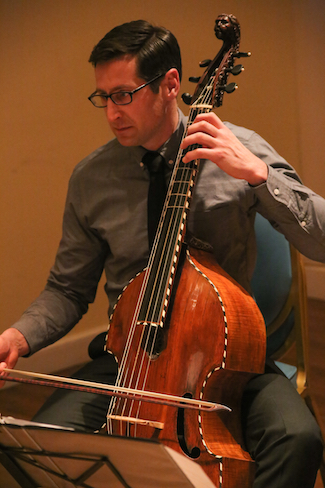
I’ve worked with this instrument before, in a piece written for the Spanish ensemble Continuum XXI, which is focused on integrating historical instruments into contemporary music. That work (“Fuentes y ríos fuego arderán” for recorder, continuo organ, baroque violin and viola da gamba) was based on the medieval chant “El Cant de la Sibil·la” (The Sibyl’s Song) from Mallorca, and then my intention was to explore the palette of extended techniques on historical instruments through the lens of saturated sonorities related with the apocalyptic prophecies of the Sibyl.
In the new work for Azrieli, however, the viola da gambas are meant to symbolically evoke the fragile timbral world of early music and a kind of ancestral resonance, to become mediators between the past and the present, a bridge between the orchestra and the choir. Some unconventional playing may appear, but the main goal is to achieve a sound of a “past” age, one that cannot be reached so efficiently with standard orchestral instruments.
I find some of your vocal music particularly compelling, including works described as madrigals. With those in mind, and given that the new work will be scored for four violas da gamba along with voices, can you describe the influence of early music in general on your work?
As I mentioned before, early music has played an important role in shaping my artistic worldview. Yet, for me, there is always a delicate balance in how to approach this material – whether to quote it directly or fragmentarily, reinterpret it, or completely deconstruct it.
Early music for me is not so much about nostalgia, but it’s rather a source of transformation. I am particularly drawn to working with and transforming vocal forms – be it the madrigals of Monteverdi, the Troubadour albas, “El Cancionero de Palacio” (“The Palace Songbook,” a Medieval Iberian vocal collection) or a current project that departs from the responsory “O vos omnes” by Tomás Luis de Victoria – this all is in line with the trajectory I am going to continue exploring in the new work for Azrieli.
Your past work encompasses electronics as well as traditional instruments and voices. What other traditions or composers, classical or modern/contemporary, have been especially influential or inspirational to you?
There have been two principal directions that have fascinated me since my student years. One is centered on the liberation of sound in its raw, physical aspect – an approach represented, or perhaps carved out, by Helmut Lachenmann and others who redefined the relationship between gesture and material through non-conventional playing. The other is the Italian tradition that runs from Scelsi to Sciarrino and Billone, where timbre becomes a form of magic, and the narrative forms a ritual.
At the same time, I try to keep a certain distance from my influences to leave space for reinterpretation. This is one of the reasons I’m so drawn to early music – it provides the temporal distance necessary to transform what we inherit into something new.
Do you come from a musical background? Did you study performance as well as composition? And was being a composer your goal from an early age?
This is a tricky one. I come from a musical family – on my father’s side, everyone was or is a musician. But becoming a composer, or even studying music, was not my goal as a child. There was no pressure from my parents to follow that path, so I first studied cinematography. It was only around the age of 19 when I decided to turn to music, starting practically from zero.
It meant a lot of catching up to do in every aspect – piano, theory, composition – so a career in performance was out of the question, but with composition I took the risk despite many people warning me that I wouldn’t be able to make it after having started so late.
After years of catching up I entered the composition faculty at the conservatory, so while I didn’t begin “early” in the conventional sense, for me it was my own “early age.” This is why I am not a big fan of generational terms like “young composer,” as early stages of a career may come at different ages, and not everyone starts in equal conditions.
A Sense of Place
The description of De l’encra escafada refers to your deep connection to Mediterranean culture. As a Romanian-Ukrainian composer, how did this Mediterranean connection develop? And how did your path lead to Valencia?
This connection has a lot to do with the search for identity and the process of reclaiming my legacy. I was born and grew up in Ukraine, which is my homeland, but for most of my life I felt detached from my Romanian roots (my grandparents on my father’s side were Romanian who moved to Ukraine). Reclaiming my Romanian heritage (as well as citizenship) was a long and difficult process of many years, and for me it was a bridge to the broader cultural sphere of Romance languages that I had always been drawn to and now I can finally say that I am part of.
Of course, this journey also brought moments of identity crisis, when at some point I felt stuck between the different cultural worlds and no longer knew exactly where I belonged. Perhaps this is why I developed such a strong connection with Spain and the Mediterranean region in general – it was the place that welcomed me with no questions and where I felt in my own element.
My first significant professional recognition came in Barcelona with the Frederic Mompou International Award in 2017, and since then, Spain was continuously calling me back. I moved to Madrid to pursue my master’s studies, later returned there for a scholarship at la Casa de Velázquez, and then eventually settled in Valencia.
Also, one of the key moments in terms of this Mediterranean connection was an artistic residency in historical Occitania, in southern France, near Perpignan, where for a time I focused on exploring the Troubadour legacy. And most recently, my journey has extended to Italy, with an ongoing residency at the Royal Academy of Spain in Rome.
But beyond professional milestones, what truly connects me to the Mediterranean is a feeling of belonging which I sometimes find difficult to explain.
What does receiving the 2026 Azrieli Commission for International Music mean to you?
It is a great honor and responsibility for me, and also a reminder that persistence is key as long as you stay true to your artistic voice and keep going despite the uncertainty.
I still remember that moment when I received a call from Sharon Azrieli informing me about the outcome of the competition – it was first difficult to believe, especially after a year marked by continuous rejections in applications for projects and open calls. That call felt like an affirmation that if you are passionate about something, you will always eventually find a way to realize your idea. And I am beyond grateful for the opportunity to be able to bring to life my idea with the trobairitz legacy within the unique and truly supportive environment of the Azrieli Commissions.
De l’encra escafada will be performed at the Azrieli Music Prizes Gala Concert on October 15, 2026 and two subsequent international performances TBD. Hear more by Adrian Mocanu online.