 Blogcritics The critical lens on today's culture & entertainment

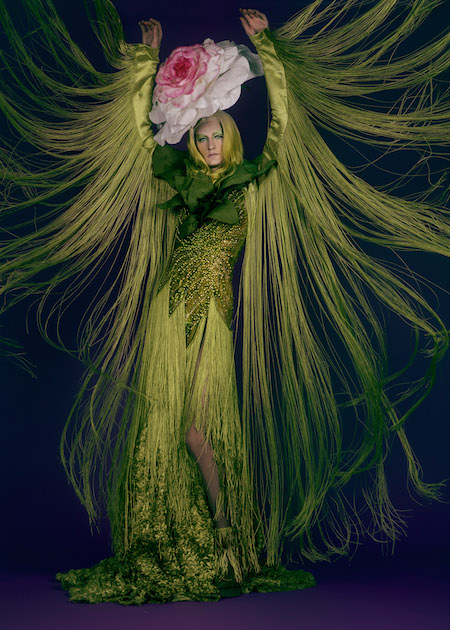
Audiences and critics have celebrated the striking small-scale adaptations of classic operas that Heartbeat Opera has staged since the company’s founding in 2014. But Heartbeat also dances to a funny, campy beat. Their Drag Extravaganza is perfect for the spooky Halloween season in New York. This year’s edition, Orgy and Bess, will run Oct. 30 to Nov. 8 at Judson Memorial Church in Greenwich Village, NYC.
In the real world, real scares abound, with rising repression of diverse Americans including drag performers, trans folk, and the LGBTQ+ community in general. In the spirit of celebrating diversity, I wanted to talk to Artistic Director Jacob Ashworth and Music Director Dan Schlosberg about Heartbeat Opera’s vision and mission, including their annual Drag Extravaganza. During a wide-ranging interview via Zoom, I got a lot of insight into Heartbeat’s genesis and artistic lens, and into what fuels its continuing success.
Opera and Drag
I’ve seen and reviewed a number of Heartbeat Opera productions over the years. But this year’s drag show will be special in several ways. For one, it’s directed by the company’s former artistic director, Ethan Heard. I was interested to know about the commonalities between opera and drag.
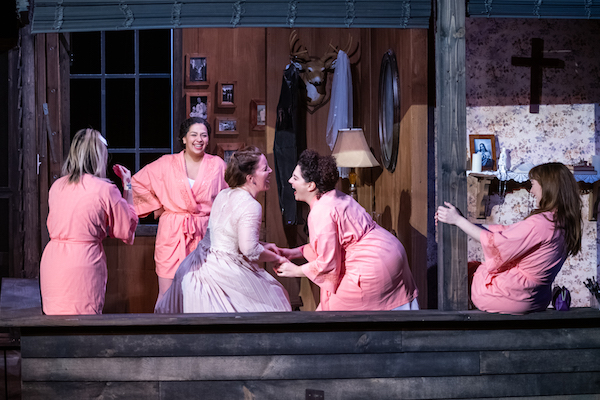
Artistic Director Jacob Ashworth pointed out that the two art forms have always been linked, and in more than one way. “There’s classic gender-binary drag in opera, men playing women and vice versa. But there’s so much more shared between the two art forms,” he said. “So in our Halloween show it’s really about gender expression of every possible kind—but also the over-the-topness that’s common” to the two art forms.
“Both serve to express, on this monumental scale, the range of human emotion that thrills and excites us so much. So there are historical ways, but also organic ways, and and we dive into both angles. Also interesting is that drag in this country is completely different than when we did our first show 12 years ago. So many elements of drag have become more mainstream—but also there are so many places where drag has become more restricted and more dangerous.”

On that score, Dan Schlosberg added that the troupe was lucky to be based in New York City, a burg of relative diversity and acceptance. “We couldn’t do this show in some places. Even opera, with some people not wanting to perform The Marriage of Figaro!…But we’re thankful that we’re here in New York and for the moment we’re able to do this in its full glory.”
Rejuvenating the Classics
Drag aside, it’s the mainstream productions that have built Heartbeat Opera’s reputation as a uniquely forward-looking and energetic champion of the genre. Schlosberg described the company’s vision of opera: “It’s theater. And treating opera like theater is the M.O. of our company.”
“It has unlocked a pathway for opera that I’m so excited about and that wakes me up every morning and compels me to do more,” he went on. “Because this art form is so rich, as we all know, and rich beyond the traditional ways that people think of doing it, at least in this country, and I hope that we can unlock that for others as well.
“I believe,” he added, “that the greatest art is able to respond to the time period. It’s not a fixed object, it’s mutable. These composers [of classic opera] generally, especially the earlier you go, would never have thought that the piece [as originally staged] was it, and that’s it.”
“What’s been really exciting is to see that the drag opera that we’ve done has the same effect,” Ashworth said. “And that people have started this all over. It’s really gotten to be known as a different style and way of working and treating these pieces, and so it has its own life and its own influence. Even things like Cats: The Jellicle Ball—there’s a rhyme here, something that’s bubbling out of all the soup of what’s happening in New York, and we’re definitely one of those things where what we do comes to life later.”
To know that the approach works, you just have to observe audience reactions, as I’ve done many times (while also feeling the effect myself). I think it’s what makes Heartbeat Opera productions stand out to me, and makes we want to see and comment on them, even though I’m no kind of an opera expert.
Vernacular Spectacular
“The audience is a quintessential and essential part of any performance,” said Schlosberg. “People come to these operas who have seen Faust 80 times, but also people who’ve never seen an opera. And both types always have incredible responses to our work, and that brings me great joy. We’re proud to show that opera doesn’t have to be elitist, standoffish, full of rules. It’s theater!”
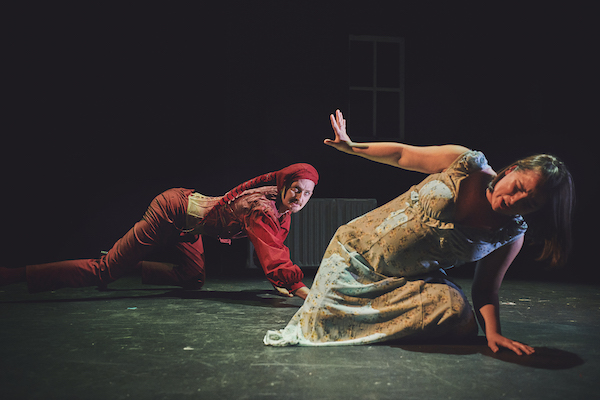
Ashworth explained that Heartbeat’s mainstage productions of classic works “are very explicitly trying to be in dialogue with classical performances of operas. It’s very intentional that somebody maybe halfway across the world might be taking an idea from our Salome, let’s say, and bringing it into their version. So we continue the conversation.
“In a Shakespeare play,” he expanded, “everything’s allowed. You don’t [normally] have that opportunity in opera.” Heartbeat is about thinking differently. “Do we need that character at all? What if we kept this thing that’s usually cut? Can we tell a story with staging rather than a ballet? What would be strange and different and weird that would actually sell our story in a different way?”
Clarity for today’s English-speaking audiences is important too. “We’re doing a lot more translation these days,” Ashworth says, “which is also a ton of work. This year is one of the biggest lifts we’ve had in years.” For their upcoming Manon they’re actually creating a singing English translation. “So adaptation is one thing, but writing every lyric—it’s a completely different amount of time to spend on that.”
Why go to the effort? “I fiercely believe that opera should exist and should be done in the vernacular, the native language of the audience, much more often.,” Ashworth said. “I think that these composers would be horrified to find out that their words are falling on people’s ears who have to read the story [in supertitles] above.
“This is our big experiment, with Manon, a big challenge to ourselves: What would it mean to do a version with no supertitles? You have to cast it right, orchestrate with that in mind, focus so much of our attitude on that. We’re auditioning opera singers but also singers who are more in the musical theater spectrum. Because this is an opéra comique, it should be immediate, people should just get it. We want it to feel like a Broadway show.
Arrangements
Dan Schlosberg’s arrangements are a key part of what makes Heartbeat beat, and that includes the drag shows. For those, he says, “Jacob is instrumental in selecting the material, with the director. Then I come in and write the arrangements. This show is interesting because it’s going to feature a few medleys of works from the operatic canon. So I’ll also do some liaising and medley-fying musically.
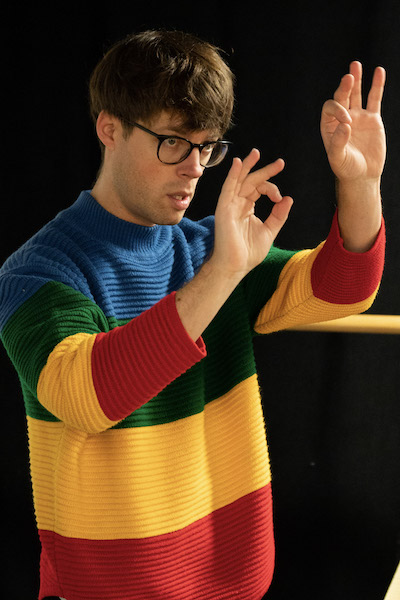
“In our normal process, I’m there working with Jacob and the director to realize the vision through the music and contribute my own particular ear to the score, within whatever way I’m inspired to do based on any number of factors. It’s different for each show, but that’s part of the amazing thrill of writing these: It gives me permission. It’s incredibly liberating for me to look at these scores with fresh eyes, without artificial constraints of performance practice or tradition that are imposed upon opera.”
Early Days
Heartbeat originated not too far from its NYC home. Ashworth and the other founders, as well as Schlosberg, met and began to collaborate at Yale, first as undergrads, then as graduate students. The company germinated from the vision of Ethan Heard and Louisa Proske, its founding Co-Artistic Directors. Since his last mainstage production, 2022’s Fidelio, Heard has returned to direct some Heartbeat productions, and the stars aligned this year for Heard to direct the drag show, co-creating it with Ashworth, with arrangements, per usual, by Schlosberg.
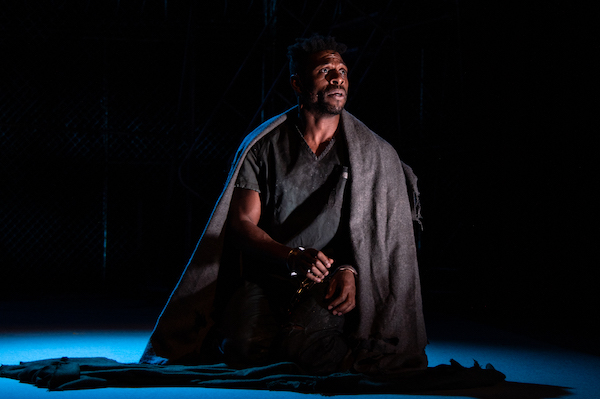
Jacob Ashworth was a professional singer from an early age. He performed in dozens of New York City Opera productions from age eight until his voice broke at 13. “I got to do things that child labor laws will never allow you to do again,” he said. But “I never quite imagined I would come back to it.” Indeed, a year before Heartbeat launched, he was collaborating with Schlosberg on a chamber ensemble he had started, Cantata Profana. (The group lasted. I caught one of their productions back in 2019.)
For Dan Schlosberg, in high school, musical theater was his thing. “Opera was what actually got me into classical music when I was really young, six years old and memorizing the words to Carmen even though I had no idea what they meant.” But there was no opportunity to do opera in high school, so musicals became the thing.
The first seed of his opera career came as a college freshman, when another writer dropped out from the undergrad opera company and Schlosberg was recruited to create a small-band arrangement for a production of Hansel and Gretel. Later, in grad school, Heard approached him about doing a nine-piece orchestration for Heard’s thesis project of Sunday in the Park with George. Et voilá, another part of the collaboration that became Heartbeat Opera was born.
Homecomings
“What emerged,” Ashworth said, was “an incredible formula for what Heartbeat would become. The director dreams up the wildest thing you could imagine, and Dan and I say, ‘We can do that,’ as opposed to when directors and music directors often say ‘No.’ Our mandate was to say ‘Yes’ to everything and see how can we keep the music level at as high a level as the rest of what’s happening.
“Four of us ran the company for the first seven years,” he recounted. “Ethan and Louisa [Proske] each got other wonderful jobs, but have stayed on the board, always stayed very involved and supportive. Then I became Artistic Director and Dan became Music Director, and we’ve created a whole new chapter of what Heartbeat is, and it’s been very rewarding and fun to get them to come back and see the shows. Ethan helped birth the drag show and it was so exciting to see his face light up as an audience member.”
Keeping It Going
And the future? When Ashworth and Schlosberg took over a few years ago, the question had arisen whether the company should keep going, and why. “It was clear to us that our artistic ambitions were still really high,” said Ashworth, “and [there were] so many projects we had left to do. We have ticked so many pieces off of our bucket list, but every new piece we program becomes a new bucket-list item that we get to do.”
Schlosberg feels lucky to “be able to do what I want to do, work with these pieces in a fresh and exciting way, use my creative energy as well as communicate with great works of art from the past, and also very important for me is I feel like we are creating a new future of opera! I don’t want to say the future, but a way of doing opera that I hope can influence the way opera is done in the future, being dramatically faithful to the text and musically extremely virtuosic and demanding, to the original intent and to whatever I come up with.”
Said Ashworth, “I feel like we’ve really discovered a way of working, a community of people, both on the artistic and the audience side, that fuel for me what’s going to come in the next few years. This is the work I love the most, it’s the most stimulating and the most difficult. We give ourselves challenges that are massive artistic, intellectual, scholarly, virtuosic, performing, logistical challenges. Every time we set up this fabulous mountain for us to climb. It’s exciting work and [the audiences] see the result, but also see the process in the piece, so you get a feeling that people have worked on this and as an audience you feel like you’re close to that and can feed off that energy. So that really keeps me going, and it’s something I think I’ll be doing as long as people will show up.”
‘This Amazing Thing’
Every production presents its own puzzles to solve. “Part of it too is that each show we do is so unique,” Ashworth said. “Each has unique collaborations and challenges, and so I’m just always stimulated by how to solve the next opera, how to bring another show to people. I’m always going for something that feels totally new and like nothing we’ve ever done before, and yet also feels intrinsically Heartbeat.”
Innovating and setting up creative challenges for oneself are all very well, but full-on opera productions are expensive to stage. How does a small company keep going?
Patronage, that’s how. Donations from supporters are a big factor, “people stepping up,” Ashworth said, “individual folks who see what is going on and feel it’s their responsibility and opportunity to help.” Funding from the city and state and from institutions is also part of the mix. (Federal funding hasn’t been a factor, although, he adds archly, “We almost decided to apply [for federal support] for the drag show so we’d get turned down so we could turn to the patrons and ask for more donations!”)
“Somehow the formula is working for us,” he went on, “and I think it’s because people are really excited about the work, more people are coming to see us and feeling you can’t wait for government or institutional giving to bolster the work, it’s time to do it yourself. We ask for money any time we’re in front of anybody, and you absolutely have to, but I like that our relationship with the people who support us is one of enthusiasm for the art. We don’t say ‘we’re in desperate need.’ We say, ‘if you come with us we can do this amazing thing.'”
Orgy and Bess will run Oct. 30 to Nov. 8 at Judson Memorial Church in Greenwich Village, NYC.