Blogcritics The critical lens on today's culture & entertainment
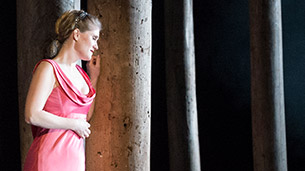
Visual and performance artist Zhang Huan‘s splendid staging of George Frideric Handel’s Semele, while occasionally incoherent, is simultaneously dazzling and suave, clever and solemn, respectful of Handel’s glorious score and inventive with William Congreve’s poetically concise libretto. Graced with excellent voices, good acting, and masterfully sensitive work from Christopher Moulds conducting the fine orchestra, the Canadian Opera Company production is a very welcome highlight of BAM’s season.
Without stinting on Handel’s beautiful music, Huan adds a number of Asian elements that transport the setting. The production begins with a documentary film clip about the restoration of an ancestral family temple in China, followed by a time-lapse film of the building of Huan’s opera set, which then, in a breathtaking moment of old-fashioned theatrical joy, gives way to a matching live set defined by a temple’s majestic roof and columns.
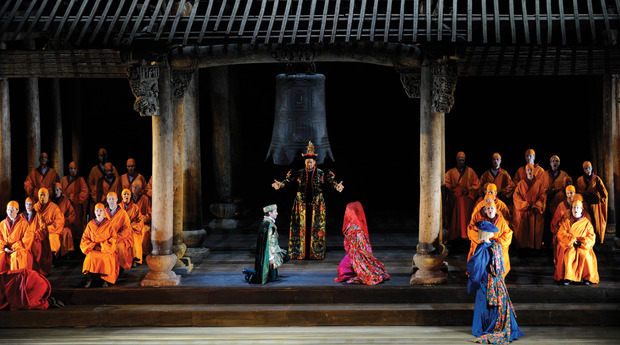
The structure serves first as the intended setting for Semele’s wedding to the ridiculous prince Athamas, who is sung and acted with confident, comic panache by countertenor Lawrence Zazzo. Later, its columns transformed into trees, the temple set becomes the heavenly bower where the rebellious Semele takes up residence with her lover Jupiter. Draped with a gigantic blanket, its roof then does double duty as the celestial bedroom of Somnus, the god of sleep.
Zhang tells us he doesn’t know much about opera, which may account for freewheeling imaginative touches like the drag-style blonde wig on Semele’s jealous sister Ino, the randy horse (played with priapic gusto by two members of the company), the stage-wide white dragon (supported by seven), and the giant balloon-like figure representing Somnus. Zhang certainly knows about spectacle, and about temperance as well, staging grand scenes with colorful pomposity laced with humor, and quieter ones in stillness.
Humor dominates Somnus’s scene. However, in that role sung from the rooftop, baritone Kyle Ketelsen’s voice had a displeasing tinny quality, something to do with the amplification or the acoustics in the BAM Howard Gilman Opera House, for in the opening act Ketelsen sounded completely natural and appropriately regal as Cadmus, King of Thebes and Semele’s father. Nowhere else did I find anything to complain about sound-wise.
Indeed, the production’s greatest glory comes not from the sumo wrestlers who give it its marketing hook – amusingly wacky as their gimmicky appearance may be – but from its female voices and characters. Jane Archibald is near-flawless as Semele, touching hearts in the sweet sad arias like “Oh sleep, why dost thou leave me?” and eliciting rousing cheers for the sparkling, sustained melismatics Handel demands of his Semele in “Myself I shall adore” and “No, no, I’ll take no less” as she reacts to the perception that she has achieved celestial beauty but continues to struggle with her conflicting desires for love and immortality.
Contralto Hilary Summers has much contagious fun as Semele’s sister Ino, then as Jupiter’s wife Juno, and later as Juno disguised as Ino – moping, preening, mugging, and wielding magic with the best of them. Katherine Whyte is in lovely voice in the smaller role of Iris, shining in her one big scene and later aping Juno to great comic effect.
Huan deepens the emotion and the exoticism with a keening solo by Tibetan singer Amchok Gompo Dhondup, which ties together the cultural elements by demonstrating the universality of the human voice in whatever musical tradition it’s employed. Ironically this extra-Handelian moment is one of the production’s most touching – a kind of flip side to the scenes of lovemaking between Semele and Jupiter (tenor Colin Ainsworth in golden-boy get-up), with their uncomfortable amount of breast-groping, though Jove partly redeems himself by washing Semele’s feet as he sings the beautiful aria “Where’er you walk.”
Some critics disdained this production when it settled in Canada in 2012. But while in some respects it may confound, it feels honest, both musically and theatrically. Who can say what Handel might have said of it, or William Congreve for that matter? But Congreve, after all, penned the famous epigram, “Music has charms to soothe a savage breast,” and this, I feel sure after seeing this Semele, Zhang Huan understands.