 Blogcritics The critical lens on today's culture & entertainment

Waiting for Lefty
Set in a union hall during the Depression and based on a real NYC taxicab strike (though Clifford Odets later lied about this to the House Un-American Activities Committee), Waiting for Lefty concludes with a rallying cry to strike. What else can workers do when they receive low wages and face high prices, poverty, hunger and sick children?
Because of its dynamic power, Odets’ play’s has unmistakable relevance. Ask Americans who have massively protested an administration that supports criminal oligarchs. When the wealthy don’t pay income tax, let alone their fair share to fund programs for the neediest, a person like actor Steven Pasquale (Bridges of Madison County, Assassins) takes notice. In fact he jumped at the opportunity to direct Odets’ play in a version with music. Now running at Classic Stage, this revival of Waiting for Lefty has been extended through December 6, 2026.
Pasquale, Yeller Tooth, Susan Misner
To lengthen the one-act to 70 minutes, Pasquale worked with original music and arrangements by Yeller Tooth. Also, he brought in choreography by Susan Misner. With these enhancements, an already timeless classic expanded into new territory.
The play opens with the resistance song “Bella Ciao” (“Goodbye Beautiful”), played by the American husband-and-wife folk music team of Sahar Milani and Cameron Scoggins. Widely adopted by labor and socialist movements, the song has its roots in northern Italy’s 19th-century folk and work songs at a time when young female seasonal rice laborers sang about harsh working conditions and exploitation by their bosses.
The Framing Device
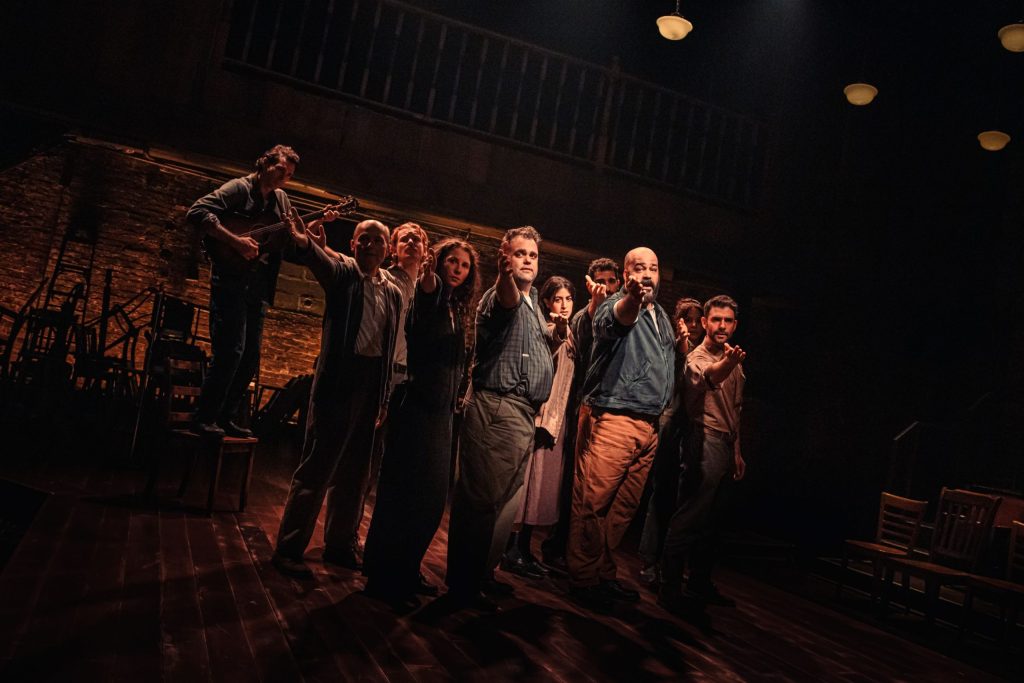
This apt musical opening initiates Odets’ framing device. In the immediate present, union workers fill the stripped-down, minimalist CSC theater space. With Mextly Couzin’s lighting design of hanging lamps and spotlights to provide shadows and atmosphere, the setting (Scott Adam Davis’ scenic design) engages us with surrealism and timeless transcendence. The final clamorous refrain of “Strike, Strike, Strike” dims to an uncertain, futuristic darkness.
With the audience sitting on three sides, immediacy and intimacy unifies the players and watchers. Presumably part of the action, we symbolize a few hundred drivers, fellow unionists, whom the leaders must energize to stand against the greed and tyranny of the company. Of necessity, the leaders’ arguments must be inspiring enough to rally the workers to take on the bosses and their violent thugs. The unionists will be risking their lives to take a stand.
Flashbacks
Many have nothing left to lose. Odets shows this in flashbacks, representative vignettes of the privations the working families face. Working 14-16-hour days with no overtime for a pittance, the unionists insist that a strike will change things. Eventually this kind of action, this play, and other cumulative actions led to FDR’s Fair Labor Standards Act and its amendments.
Throughout, and more noticeably toward the conclusion, actors playing drivers sometimes interject from the audience. Loudly rebuking the company owners, they argue with the co-opted, corrupt union boss, Harry Fatt (Greg Hildreth), whom the company most probably pays to prevent the strike.
In flashbacks Odets shows the justification for striking. For example, cabbie Joe (Raffi Barsoumian) argues with wife Edna (Tala Ashe, Tony nominee for English) about their impoverished home life. It concludes when she tells him she’s seeking material comfort with another.
Lefty
Flashing to the present union meeting, the members are continuing to wait for Lefty (Zach McNally), the elected chairman of the strike committee. A symbolic, Godot-like figure in Odets’ original script, made alive without dialogue by Pasquale, he ambles around the playing space in a dream-state via Susan Misner’s choreographed movement. Intentionally opaque, Lefty appears to be returning to the meeting as they wait. However, by the conclusion we realize his movements suggest something else. In fact all of Misner’s movement relates to the struggle of the workers to get to the next day. Some movement relates acutely, powerfully.
The Lab Assistant
In a particularly prescient vignette, Miller, a lab scientist (Austin Durant), confronts Fayette, his boss (Henry Stram), in a devil’s bargain for a promotion. The industrialist wants him to assist Dr. Brenner in making poison gas for chemical warfare that will kill humans in future wars. Miller objects in the name of human decency to the highly classified government project. He reproaches Fayette, reminding him that millions died in the last horrific war, including Miller’s own brother. Fayette makes an argument characteristic of oligarchic weapons manufacturers, bankers who fund wars, and oil companies everywhere. He says, “If big business went sentimental over human life, there wouldn’t be big business of any sort.”
Miller faces a moral dilemma when Fayette offers even more money for him to spy on Dr. Brenner. Miller responds sharply, but the project continues when Fayette finds someone without a conscience to do his bidding. The foreshadowing of the poison gas used in Auschwitz looms in this vignette.
Music and Song
The music and songs truly stand out. They carry the throughline of human struggles between the wealthy and the needy. In fact the songs elevate Waiting for Lefty beyond “agitprop” to a universal spiritual resonance. Interspersed among the union hall speeches, rallying cries and titled “episodes” by Odets, the well-known folk and protest standards connect.: Yip Harburg and Jay Gorney’s “Brother Can You Spare a Dime,” “Union Song” with lyrics by Woody Guthrie and music by Billy Bragg. A knockout led by Hildreth and Adam Kantor, “If I Didn’t Care,” ironically suspends the action with “young love and hope.” Then the song drifts off and the quick switch happens. Pro and anti union workers argue, dropping the audience back into the fray of fighting in the midst of misery and want.
This memorable Waiting for Lefty puts a vibrant spin on a relevant, impressive work which speaks to us today, and most probably will continue to, as long as greedy plutocrats hold sway.
Waiting for Lefty runs through December 6, 2026 at the Classic Stage Company.
Special Event: During the extension week, a special Thanksgiving Eve matinee on Wednesday, November 25 at 2:00 PM features $66 tickets (including fees) as a thank-you to the community.