 Blogcritics The critical lens on today's culture & entertainment
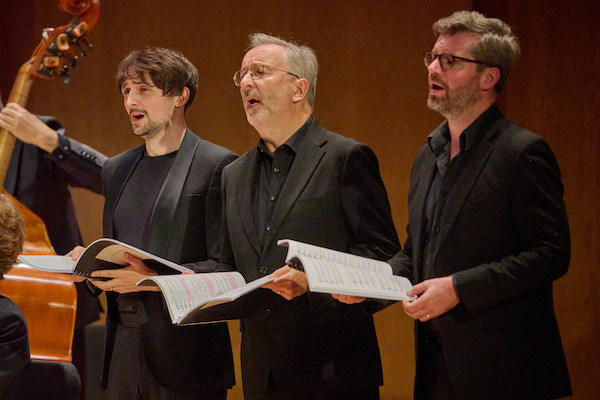
Les Arts Florissants is a baroque and early-music ensemble of singers and musicians with a cheekily theatrical bent. While adept at pristine harmonizing and austere plainchant, and at precise vocal and instrumental performance informed by rigorous scholarship, the group prioritizes something equally important: putting on a good show. Case in point: their sprawling and brilliant 2024 production of Henry Purcell’s The Fairy Queen under a huge tent at Caramoor.
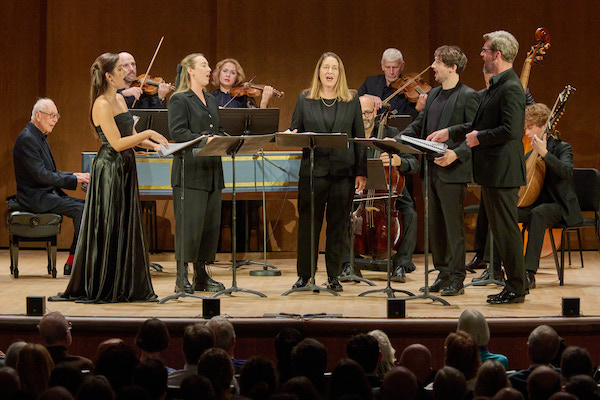
But Les Arts Florissants’ colorful extroversion emerges at traditional concert halls too, without the costuming and staging and all the trappings of operatic story. At the group’s all-Monteverdi program at 92NY in New York on Tuesday night, co-music directors William Christie (keyboards, red socks) and Paul Agnew (tenor, mugging) led a baker’s dozen of top-notch singers and instrumentalists in a set of madrigals from various stages and aspects of the great Italian innovator’s music.
We heard dances and romances, tales of battle and grief-stricken laments, accounts of the plight of the lovesick and the glories of nature, and more.
Monteverdi’s Secular Side
The theatrical expressivity emerged right away with the aria-like opening of “Volgendo il ciel” from Monteverdi’s final collection of madrigals, his Book 8. The song concludes with five voices urging listeners to “move your nimble feet” in honor of a military victory that “turned the fields crimson.” (The supertitles were very helpful.) Maybe that isn’t something most of us would care to glorify these days, but the celebratory dance-tune was infectious.
The singers went on to establish their a cappella bona fides with more palatable glorifications: of kisses as “a sweet death,” and of the dawn.
The performance by soprano and mezzo of the love duet “Chiome d’oro, bel tesoro” reveled in the song’s expressive potential, as when the arrangement lingered almost comically on “blessed wound.” (The poets of the time made much of love as a metaphorical death.)
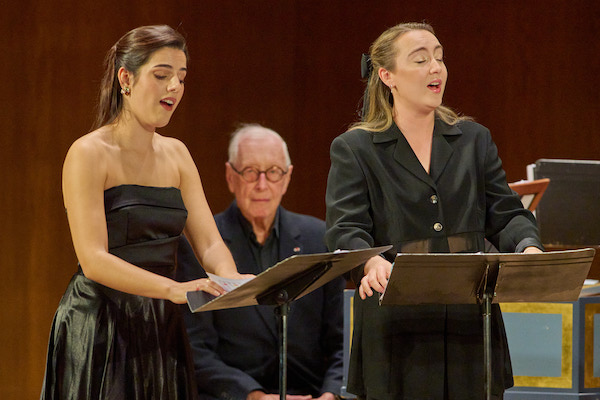
“Lamento della Ninfa” was especially dramatic, with the three male singers sighing dissonantly about the grief of an abandoned woman. She then appears (cue the soprano) to sing of her woes as the instrumental ensemble intones a descending four-note basso continuo over and over.
“Si ch’io vorrei morire” (“Yes, I wish to die”) heightened the stagy fun and the humor, with rather graphic verbal and musical depictions of lovemaking. A big and impactful rendition of a madrigal in six voices (instead of the more common five) then closed the first half.
Battle of the Sexes
“Combattimento di Tancredi e Clorinda” is Monteverdi’s setting of an episode from Tasso’s epic poem Gerusalemme liberate. In this bloody armor-clad battle between Tancredi and Clorinda, he can’t see her identity (or sex). Baritone and mezzo-soprano portray the combatants, but the bulk of the singing is from the narrator, Testi. That role was floridly undertaken by rich-voiced tenor Paul Agnew, who is adept at chewing non-existent scenery. This sort-of-madrigal is like a little play, even including patter-like passages.
Throughout the concert Agnew was fun to watch as he directed the vocal ensemble from its ranks, his gesticulations and expressions heightening the theatrics.
Also energizing the second half were the counterpoint of a soprano-mezzo duet, the springtime sadness of “Zefiro torna,” and the all-hands-on-deck finale, “Tirsi e Clori,” with its “Let’s dance” prompting. No one in the audience actually got up and danced, but that song had much of the feel of a musical-theater closing number.
Despite the preponderance of canes and bent, greying heads in the audience, the whoops and cheers after the most rip-roaring numbers had a more excited quality than the “bravos” one typically hears from classical-music crowds. Les Arts Florissants brings early music to life like few ensembles can. Find their touring schedule on their website.