 Blogcritics The critical lens on today's culture & entertainment
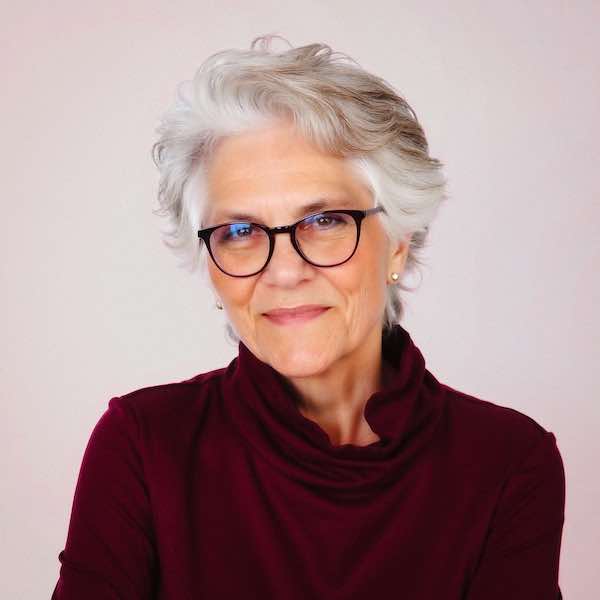
The Azrieli Foundation has just announced the recipients of the 2028 Azrieli Music Prizes (AMP). These biennial awards recognize composers of distinction and give them resources and a platform “to create music of enduring value.” The three 2028 laureates have distinguished themselves for just that already, and we spoke with each of them about their work, their backgrounds, and the compositions they will be creating for the 2028 Azrieli Commissions.
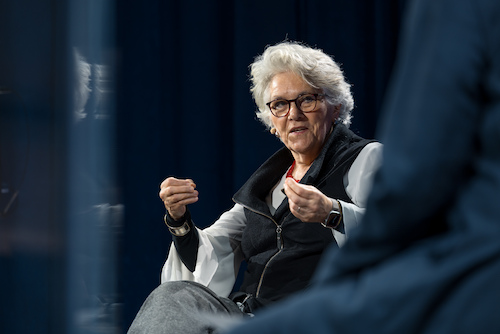
Today, we present composer Linda Bouchard, recipient of the 2028 Azrieli Commission for Canadian Music.
Bouchard has enjoyed a 50-year career as a composer, conductor, orchestrator, researcher, mentor and more. She has received the Composer of the Year Award from the Conseil québécois de la musique and served as composer-in-residence with the National Arts Centre Orchestra in Ottawa. Analekta, ECM, Bang on a Can and others have recorded her works.
Through the decades she has often lived, studied, and worked outside her native Québec, notably in California and New York City. But she has always retained Montréal as her “home port,” and receiving the Azrieli Commission for Canadian Music reinforces a continued identification with Québec and Canada that can manifest in her compositions.
The anchor point for her new work, titled Le Saguenay, Saki-nip, is the strong sense of connection she found in the book Le peuple rieur: Hommage à mes amis Innus (The Laughing People: A Tribute to My Innu Friends) by Serge Bouchard and Marie-Christine Lévesque. Linda Bouchard describes the book as “paint[ing] the portrait of a crucial period in the history of French Canada” – namely, the early contacts between French explorers and the Indigenous Innu people of the area. “Composed of short, gripping stories, it reveals the human depth of events often forgotten. Beyond their historical grounding, these stories convey a universal message where memory, friendship, and resilience echo throughout.”
Intercontinental Inspiration
I asked her how, musically speaking, she viewed her connection with her homeland, or with North America as a whole, as distinct from the European classical musical tradition. But I learned that she doesn’t make such a distinction.
“I consciously chose to study in North America,” she said, “not to deny the richness of the European tradition.” Rather, “the music of European composers has greatly influenced me, including music from the 19th and 20th centuries.”
However, she went on, “I intuitively wanted to give myself the opportunity to develop my sensibility as an artist” rooted in North America – reflecting the values, the architecture, and even East Coast weather patterns.
She headed to New York City because she wanted to sustain a feeling of being “somewhat uprooted. But I stayed deeply connected to Québec, spending my summers in a cabin to compose music.”
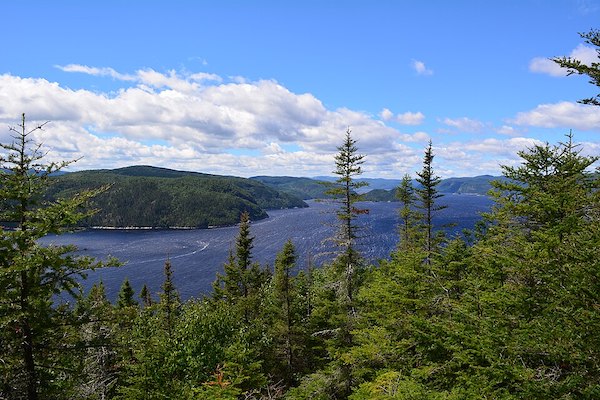
Her new work references both the composer’s family history in the region and those early historical encounters between the Innu communities and French explorers. But perhaps more directly, it is also a portrait in sound of the Saguenay Fjord, a dramatic waterway some 100 miles north of Quebec City.
Natural phenomena, like waterways, have inspired Bouchard’s compositions for decades. She describes her music as rooted in “geometry, structure and texture.” These, she explained, are “all elements found in nature that inform directly the composition of a musical work. I observe water patterns, gas movements, rock formations – and they create soundscape[s] in my mind.”
Specifically, “the Saguenay Fjord is a powerful waterway that carries the history of French Canadians, their collaboration with the Innus, their love of nature. The spectacular cliffs express emotions in me that I hope to be able to describe in music.”
A related association is the “Legend of Saguenay,” which she has described as “a foundational myth of Québec which describes a fabulous land rich in gold, diamonds, rubies, and copper. The legend may well have been a ruse from the Iroquois to send the European explorers upstream and leave their people alone.”
The piece will unfold in a cyclical structure: contrapuntal lines, like intimate conversations will emerge from the strings; traces of reels and piccolo melodies will emerge—light, fleeting, half-erased memories—contrasting with the vast expanse of the fjord, where the strings’ dialogues will be obscured by the brass and woodwinds, flashes of light suddenly surfacing or rocking waves born from the play of densities that erase and reshape a shoreline.
The confluence of natural phenomena with formal structure has been a continuing theme in Bouchard’s music. For Le Saguenay, Saki-nip, the nucleus is a waterway. I asked her to point to a past example in a finished work. She talked of her 2001 work Brasier (fire), for chamber orchestra. There she explored a different “element” (fire) and “three psychological states as metaphors: witnessing from a distance, being consumed, and remembering.”
In that work, “the orchestral palette is specific to each section. The first part is reserved for percussion, marked by metallic bursts and powerful crashes (we see a fire from a distance, for example). In the middle section, the tutti of brass and woodwinds emerge suddenly, like blocks (flares) crossing and overlapping. The final section is a subtle variation of the preceding harmonic and rhythmic section, perceived as in a mirage.”
Receiving the Azrieli Commission for Canadian Music was no mirage. Indeed, the AMP prize package, now valued at CAD 250,000 per laureate, is Canada’s top music composition competition and one of the world’s largest. “I was honored and happily surprised!” Bouchard told me. “There is so much talent in Canada. The ‘young lions’ are pushing forward with their singular voices and composing very good music. I suspected that in the case of a ‘competition,’ the promising vigor of the young composers would ‘win’ over a ‘senior’ composer with what might be a predictable aesthetic in the eye of a jury. I am deeply touched that they saw something in my music and my project that they wanted to support.”
In addition to a cash award, the package includes a performance of the work by Le Nouvel Ensemble Moderne (Le NEM) at the AMP Gala Concert in autumn 2028; two subsequent international performances; and a commercial studio recording of the work, also featuring Le NEM. For Bouchard the collaboration will continue a long and fruitful association, as she has composed for Le NEM three times before, with Ressac (1990), Musique Défilé (1999), and Fracas (just last year).
Stay tuned for our interviews of the winners of the 2028 AMP Commissions for International Music and for Jewish Music.