 Blogcritics The critical lens on today's culture & entertainment

Our profile series of the three 2028 Azrieli Music Prize (AMP) winners concludes today with our interview with Spanish composer Luis Arias, the Azrieli Commission for International Music laureate for 2028.
Though still early in his career, José Luis Valdivia Arias is no stranger to awards and recognition. In 2024, he received Japan’s Toru Takemitsu Composition Award. In the same year, his piece Al-Zahra won the Ibermusicas Prize. His piece Cyberpunk was composed for the 20th Anniversary of the Lucerne Festival Academy and premiered at the Lucerne Festival.
Arias’ piece for the Azrieli Commission is titled Optimized for Loneliness. He explained that it “reflects on how digital mediation transforms the perception and memory of culturally embedded ritual practices, specifically the Semana Santa processions in Andalucía, which form a foundational sonic environment in my musical experience.”
Many composers allow a degree of serendipity into their process – an element of the unplanned. But I was struck by what Arias said in an interview posted on his website: that his method is “to write the music I hear, and to dare to fail.” He also writes of of “a chaotical way that I approach composition…I don’t have any rules, or I don’t know them.”
That’s a brave statement to make, but the method seems to work for him.
However, for Optimized for Loneliness Arias has determined the instrumentation, and the fixed media is timed so that the ensemble and electronics can be precisely aligned. So I wondered whether, with these aspects pre-planned, there would still be a “chaotical” element to the development of the score.
Answering, the composer waxed philosophical. “We live in a world where so much changes that our beliefs and strategies have to change with it – and I think composition is no different,” he said. “The flu virus is a strange analogy I keep coming back to: It keeps mutating into something different from what it was before, which is why we need a new vaccine every year. It would be wonderful to find the formula, the one technique that works forever, but very few solutions actually do.”
Coming back to the matter at hand, he went on, “So yes, even with the instrumentation fixed and the electronics precisely synchronized, the chaos in Optimized for Loneliness hasn’t disappeared. The material itself “oppresses” the ensemble – it exerts control over the players, constantly pausing and interrupting them, forcing them to randomly switch material. It’s about an environment of rapid disorientation.”
High, Low, and in Between
Arias doesn’t believe in a distinction between “high” and “low” art. A critic wrote that his Opus 1, Arya, displayed “one of the finest examples of cohesion between popular and academic music I have ever heard.” His recent works for large orchestra also seem to include elements of melody and rhythm from popular or traditional music. So I asked him if listeners should expect a similar cohesion in Optimized for Loneliness.
In answer, he evoked the technological environment of his upbringing. “I grew up alongside the internet – the computer and smartphone era, memes, Instagram, likes. My head is this absurd, disorganized library of every genre imaginable: TikToks, video games, Hollywood, pop culture, all tangled together. None of it exists as something separate; it all coexists.
“Andalusian and Spanish culture are part of that same library too.”
So the answer is yes – not because of an intentional method, but because of who he is. “So yes, listeners can expect that same cohesion in Optimized for Loneliness – not as a stylistic choice, but because that’s simply the material I’m made of.”
Regarding specific material he’s drawing on for the new work, he describes the Semana Santa processions as “traditionally immersive collective events in which sound, space, and presence are inseparable: marching bands moving through dense urban environments, distant brass resonance shaped by architecture, and collective silence structured by shared attention and ritual temporality.
“In contemporary experience, however, this ritual is increasingly accessed through digital fragments: short videos, livestream excerpts, and circulating sonic traces. Continuity is replaced by discontinuity; embodied experience becomes fragmented and reassembled through mediation.”
Thus, “the work does not aim to represent Semana Santa, but explores its transformation into circulating cultural memory, and how this shift alters perception itself.”

Sui Generis?
Everyone in Arias’ generation grew up amid the swirl of internet culture. I wondered what it was that set him, in particular, on the path to becoming a composer.
As it turns out, he wasn’t marinated in musical ambition from an early age at all. Like Mathew Rosenblum, winner of the Azrieli Commission for Jewish music (profiled here [LINK]), Arias didn’t come from a musical family.
“Nobody in my family has ever been a musician,” he told me. “I came to music quite late, starting at 16, and everything accelerated from there – eventually leading me to a master’s at Codarts and then the Royal College of Music.
“There’s a line in the film Oppenheimer where Niels Bohr tells Oppenheimer that algebra is like sheet music – the important thing isn’t whether you can read it, but whether you can hear it. That’s close to how I experienced my own path: I came to the technical side late, but I think that’s exactly what let me hear the music in my own personal way.”
Going further, he said that he was “more influenced by things outside the classical music world than within it, even though the technique itself is still mostly learned inside it.” Thus he speaks of the composers he admires less as influences and more as those “whose work has genuinely resonated with me – Thomas Adès, Francisco Coll, Andrew Norman, among many others.
“What stimulates me about them is both conceptual and about understanding what’s happening in the 21st century, as well as how skillfully they translate their ideas and concepts into music.”
Arias’ Azrieli commission sits on a plate that’s been “incredibly full” over the past year. He completed an orchestral work that the WSR Sinfonieorchester performed, which received a Luciano Berio Honorable mention prize. He’s submitting another new orchestral piece, which he hopes to premiere soon, to competitions.
And with all that, Arias has a day job. “I also work as a rail traffic controller at Spain’s national rail operator, on a rotating shift schedule.” Music and making a regular living, he said, is “a demanding balance.” And yet, “composing has never felt more alive to me than it does right now.”
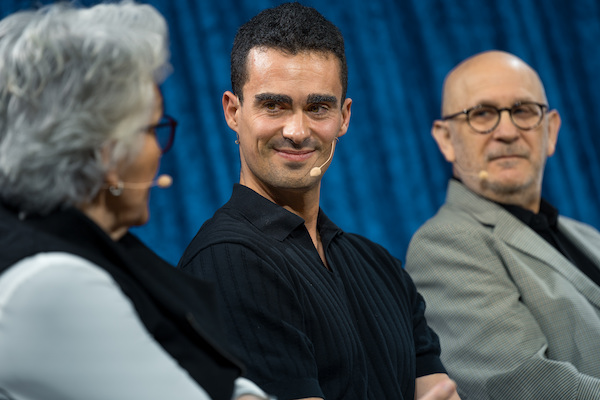
The AMP prize package is a major boost for any composer. It’s Canada’s top music composition competition and one of the world’s largest. Valued now at CAD 250,000 per laureate, it includes a cash award, a performance of the work by Le Nouvel Ensemble Moderne (Le NEM) at the AMP Gala Concert in autumn 2028, two subsequent international performances, and a commercial studio recording of the work that will also feature Le NEM.
Receiving the Azrieli Commission for International Music came as a genuine shock, Arias said, and made him “intensely happy.” It also came at “exactly the right moment. I had just started wanting to write for large ensemble and to begin incorporating fixed media into my music, and the Azrieli Commission arrived as a complete godsend. It gave me the perfect frame to explore exactly what I was already longing to explore.”
See our interviews with the other winners, Linda Bouchard (Azrieli Commission for Canadian Music) and Mathew Rosenblum (Azrieli Commission for Jewish Music)