 Blogcritics The critical lens on today's culture & entertainment
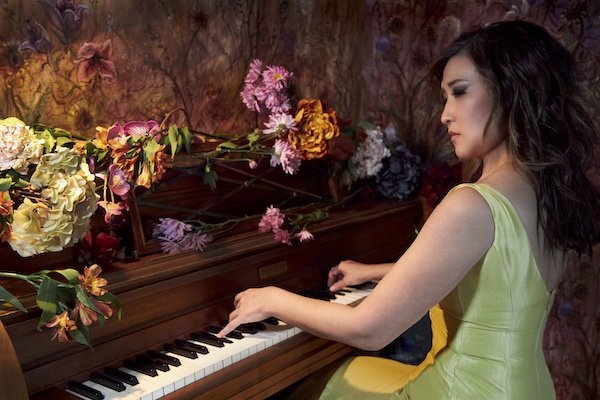
“Art nourishes the human soul like nothing else can.” – Min Kwon
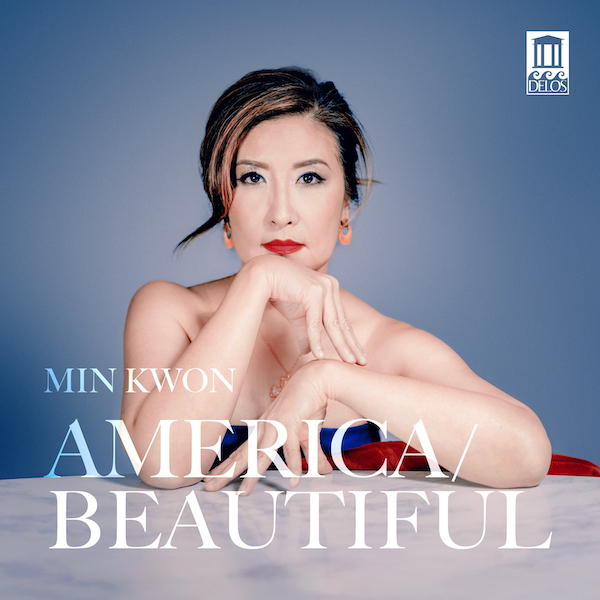
The COVID-19 pandemic has receded into memory. But during the many months of empty touring schedules, musical artists created a tremendous amount of work. Some of that work is still developing and finding audiences. Case in point: America/Beautiful, a sequence of 76 piano variations on the song “America the Beautiful,” each written by a different contemporary composer, and all commissioned by pianist Min Kwon.
The participants ranged in age from 21 to 96 and represented more than 30 cultures and countries of origin. This reflected Kwon’s goal of celebrating “the cultural diversity within America, and…encourag[ing] a variety of voices to engage with the question: ‘What is America? Is it beautiful, was it ever, or will it ever be?'”
The Korean-born American pianist is the Professor of Piano at Mason Gross School of the Arts, Rutgers University since 2002. Kwon is also founder and director of the Center for Musical Excellence, a nonprofit dedicated to mentoring and supporting gifted young musicians.
Kwon premiered America/Beautiful at a series of livestreamed concerts back in July 4–8, 2021. A box set of the recordings will be released on May 8, 2026 on Delos. Kwon was kind enough to spend some time answering our questions about this unique and ambitious project – which she now sees as a mission – and more.
Your aim with America/Beautiful was to “paint a sonic picture of [your] adopted country in all of its sprawling complexity, and ultimately try to find the beauty at the core of the American experiment and its credo of e pluribus unum (out of many, one).” How well do you think this vast “sonic picture” has explored the beauty of America? Has it “found” it?
The project is still building, expanding, and evolving.
The perspective and relationship I had with each piece when I first learned, premiered, and recorded them feels very different from how I play them or feel about them now, for example.
America/Beautiful has been a life-changing project for me – not only as a pianist or artist, but as a human being. I don’t want to call it a “project” anymore, as it has become more like a “mission” for me.
When I began it, it was with three simple goals:
- Wanting to unite people of different backgrounds and beliefs (composers/creators) for a shared purpose: to reflect on and wrestle with the idea of beauty in this country at a time when our country was not very beautiful.
- Wanting to give listeners something meaningful and moving – a sense of solace or hope, a time-stamp of a historically crucial moment in America.
- Leaving something lasting for other pianists to share for a long time to come that represents “American” music.
To me, this beauty is not something fixed, or simple to “find” once and for all. It lives in the act of bringing many voices together, to “endure” and “refine” (as two of the pieces suggest), and in all of us working hard and tenaciously to cultivate it.
As someone who came to this country from elsewhere at a young, impressionable age, one of the first things that struck me about America was its extraordinary diversity. I was amazed by the range of faces, histories, energies, and cultural inheritances existing side by side.

Over time, I came to see that as one of America’s deepest strengths: its abundance of voices and perspectives. This project tries to honor that richness. Each composer brings a distinct language, and together they form a tapestry that is complex, imperfect, emotional, sometimes contradictory, but deeply alive and moving.
One of the first things that struck me about America was its extraordinary diversity.
So yes, the project has found beauty – not in a simplistic or decorative sense. It has found beauty in the honesty of expression, in its plurality, in coexistence and aspiration within the collection, and hopefully in our willingness to keep listening to one another. And for me, that is very much the promise of e pluribus unum.
Changes of Venue
You have more performances of the program coming up in the spring of 2026, as well as the five-disc set coming out on May 8. The launch in 2021 included performances at one of my favorite venues, the Catacombs in Brooklyn’s Green-Wood Cemetery, and you’ll return there for six concerts in June 2026. What other kinds of venues are presenting America/Beautiful in the coming year, and what can people expect from the performances?
One of the most beautiful things this project has done for me is expand my sense of where this music belongs. Of course I enjoy the concert hall, but America/Beautiful has made me want to bring this repertoire into spaces that are more inviting to all types of people – places that are visually, acoustically, and emotionally embracing, where listeners can encounter the music in a more immersive way.
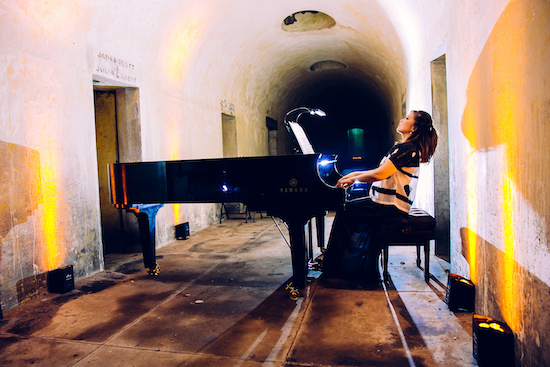
That is part of what makes the Catacombs so special (and I am so glad it’s one of your favorite venues!). It is sonically resonant, visually haunting, and emotionally charged.
When I first premiered about 20 pieces of the project there, with most of the composers present and only a few feet away from me, it was both exhilarating and terrifying at the same time. Everything felt immediate. I had only just learned the works, and many were being heard for the first time.
Now, after living with this music for several years, I feel I know it more deeply. The relationships between myself and each composer, and between myself and their music, have ripened.
Hearing [young pianists] take ownership of this repertoire is incredibly moving.
This coming year, audiences will encounter America/Beautiful in university settings, community-centered spaces, interdisciplinary contexts, and venues that invite reflection beyond the traditional recital format. They can expect to experience many sound worlds, many emotional registers, many ideas of America placed in conversation with one another.
What has become especially meaningful to me is that this music is now beginning to live beyond me. I am now teaching many of these works to young pianists, and hearing them take ownership of this repertoire is incredibly moving. New American piano music must not only be premiered; it must be passed on and played on. By the end of 2026, many of the pieces from the collection will have been performed by more than 70 other pianists, in California, Seattle, Dallas, New Jersey, New York, and even in Vienna!
And how are you feeling about the project now, after a few years have gone by and in the current political climate? Does having lived with this music for some time offer you perspective on what’s happening in the country now?
When I began the project in 2020, I was responding to a moment of fracture, isolation, uncertainty, even chaos.
I wanted to create something unifying and hopeful, something that could serve as a meaningful, affirmative artistic response during a time when so many people felt disconnected from one another and from a shared sense of purpose.
What moved me then, and still moves me now, is that 76 composers could unite around one idea: to reflect on this country, to celebrate it, to question it, and to imagine it more beautifully.
That act alone felt deeply hopeful to me. At a time when people were divided, exhausted, and often unable to gather, these artists still came together in spirit. That, to me, was already a profound statement.
When I began the project in 2020, I was responding to a moment of fracture, isolation, uncertainty, even chaos.
Living with this music over time has only deepened my understanding of the country and its people. The project now feels more like an ongoing conversation – something unfinished, and in progress, and very necessary. America itself is in a constant act of becoming. Every day, I am touched and humbled to experience, through this music, how each composer responded with such honesty, imagination, and generosity.
Beautifully Multidisciplinary
I see on your schedule a “recital marathon” for America/Beautiful at Rutgers University in May, as well as a couple of dance performances. What’s on the menu for these?
This is a particularly exciting season because the project is continuing to expand in scope and form. I was recently named the Rutgers–New Brunswick Laureate for 2026–27, and that honor is allowing me to imagine even more ways for America/Beautiful to move beyond the campus and into the wider community.
That has always been central to my mission: bringing people together through art and creating meaningful connections across disciplines and audiences.
One especially moving development is that several of the America/Beautiful pieces have now been choreographed by the gifted choreographer Phil Chan.
A suite drawn from works by Terry Riley, Vijay Iyer, Nico Muhly, and Rutgers alumnus Andrew Bambridge has taken on new life through dance. Seeing these works embodied by young dancers was deeply emotional for me. To witness movement, music, and youthful energy come together on stage was one of those rare moments when you feel why art matters.
The piano marathon at Rutgers on May 2 also reflected the project’s interdisciplinary spirit. Alongside the music, I collaborated with a Korean-American visual artist whose work resonates strongly with the themes of America/Beautiful. Bringing visual art – particularly American landscape – into dialogue with the music creates another dimension of reflection, another way of considering identity, memory, and belonging. That combination of sound, movement, and image feels very true to what the project has become.
What else will you be performing or recording in the coming year? And, if I can ask, what are you practicing right now?
At the moment, I am living in many musical worlds at once, which I actually love.
As a piano professor, I am in the heart of the semester, with several doctoral students preparing major recitals. The audition season has also meant hearing an enormous range of traditional repertoire – Bach, Beethoven, Brahms, Ravel, and beyond. So in a way, even when I am not practicing those pieces myself, I feel artistically nourished by them every day.
Performance-wise, I am always grateful to keep chamber music close to my life. This summer in Vienna – a city and festival with which I have had a long association of almost 20 years – I will perform the complete Zauberflöte (Mozart’s The Magic Flute in the Zemlinsky arrangement [for piano four hands], with my Viennese partner and colleague, Robert Lehrbaumer.
And with my trio, Kwon-Rostad-Johnson, we are exploring new repertoire for piano, clarinet, and viola that I am very excited about.
Mission: Future Excellence
The Center for Musical Excellence marked its 15th anniversary last year and continues to offer opportunities for top up-and-coming musicians. Has the focus changed at all, or have the methods and specifics evolved, over that time?
I think the work has become increasingly individualized over time, and I see that as a very positive evolution.
The Center has always been intentionally small and personal. We are a boutique nonprofit, and I am proud that we operate quietly. We do not pour resources into marketing, staffing, or publicity; instead, we try to direct our energy and resources toward the young artists themselves.
One of the most meaningful things we can do is create transformative encounters.
That can mean many things. Sometimes it is financial support. Sometimes it is access – to instruments, mentors, experiences, or networks that a young artist might not otherwise have. One of the most meaningful things we can do is create transformative encounters.
I still think about moments when major artists have given extraordinary time and generosity to our young musicians. Those experiences can change a life.
What has also expanded is my sense of what kind of musical growth we should encourage. We have recently begun opening more doors toward jazz as well, which is exciting to me.
The core mission remains the same: to support gifted young artists not only financially, but imaginatively and humanly.
I ask this of many artists who both teach and concertize: How do you balance the different arms of your career?
I wear many hats: performer, teacher, head of piano, curator, nonprofit director, fundraiser, mentor – and of course mother, wife, and daughter to an elderly parent. There are many days when I feel I am falling short in all of them.
When things get overwhelming, I do sometimes think about which part of my life I can let go of, and the answer is always the same: nothing. I need all of it.
I need to be a teacher – the engagement with students and the next generation of artists is essential to me.
I need to keep performing; otherwise, what I teach does not feel fully grounded or valid.
And I need my family – watching my two daughters grow into remarkable human beings is my greatest accomplishment.
I have had to accept that I cannot do everything, or do everything well all the time.
In the end, what sustains me is love – love for music, love for young artists, love for my family, and love for the art itself, knowing that art nourishes the human soul like nothing else can.
America/Beautiful is out May 8, 2026 on Delos.
The composers on the collection range from up-and-coming to prominent to legendary. To name just a few of the better known: Avner Dorman, John Harbison, Samuel Adler, Robert Sirota, Aaron Jay Kernis, George Lewis, Richard Danielpour, Jake Heggie, Vijay Iyer, Terry Riley, Gity Razaz, Nico Muhly, Timo Andres, Victoria Bond, Stewart Copeland, Jed Distler, Reena Esmail, Stephen Hartke, Fred Hersch, Tania León, Paul Moravec, Paola Prestini, Shulamit Ran, Augusta Read Thomas, and Trevor Weston.
For more on the project visit the America/Beautiful website.